
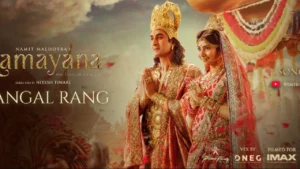
AR Rahman’s latest Ramayana track has triggered a debate over its musical influences, with some listeners questioning whether its qawwali-style sound suits Rama and Sita’s wedding.
A R Rahman, the two-time Oscar-winning composer, has drawn criticism from some social media users over Mangal Rang, a wedding song from Nitesh Tiwari’s upcoming film Ramayana. Released on October 25, 2026, the Hindi track features Arijit Singh and Shreya Ghoshal. While the song portrays the relationship between Rama and Sita, some listeners have questioned its perceived qawwali-style influences and compared its sound with Rahman’s earlier compositions. The discussion comes ahead of the film’s scheduled theatrical release on November 5, 2026.
Why has the AR Rahman Ramayana song Mangal Rang drawn criticism?
The AR Rahman Ramayana song has attracted attention because of differing opinions about its musical style. Some social media users have questioned whether the perceived qawwali-like elements suit a wedding sequence featuring Rama and Sita.
Qawwali is a musical tradition associated with Sufi devotional expression. Its characteristic vocal arrangements, rhythmic patterns and musical build-ups have influenced many forms of South Asian music, including film soundtracks.
Some listeners have also compared parts of Mangal Rang with Rahman’s earlier composition Kun Faya Kun from Rockstar. Others have expressed reservations about the musical direction chosen for a story with religious and cultural importance.
However, these comparisons represent listeners’ interpretations of the music. A perceived similarity between two compositions does not, by itself, establish that one has copied the other. No evidence presented in this article establishes plagiarism.
The discussion also raises a broader question about how filmmakers should approach music for stories that audiences already know through religious traditions, television adaptations, theatre and literature.
Some listeners may prefer arrangements that draw more visibly on familiar devotional or traditional sounds. Others may welcome a contemporary soundtrack that combines different musical influences. These are different artistic expectations rather than proof that one approach is inherently correct.
What is Mangal Rang, and who created it?
Mangal Rang presents the wedding and relationship of Rama and Sita in Ramayana. The music video features Ranbir Kapoor as Rama and Sai Pallavi as Sita, with scenes depicting their journey from Sita’s swayamvar to their wedding and life together.
The song was released on October 25, 2026, following an earlier showcase at a launch event in Chennai on October 22. It is part of the film’s musical presentation ahead of its theatrical release.
Here are the key details of the Hindi version.
| Song detail | Information |
| Song | Mangal Rang |
| Film | Ramayana |
| Composer | A R Rahman |
| Singers | Arijit Singh and Shreya Ghoshal |
| Hindi lyricist | Dr Kumar Vishwas |
| Rama | Ranbir Kapoor |
| Sita | Sai Pallavi |
| Director | Nitesh Tiwari |
| Scheduled theatrical release | November 5, 2026 |
The song has also been released in Tamil, Telugu, Kannada and Malayalam. Each version features different singers and language-specific lyrics, extending the soundtrack’s reach beyond Hindi-speaking audiences.
The film also brings Rahman together with Hans Zimmer for their first collaboration on an Indian production. Their involvement has drawn attention to the musical scope of the project.
Who is A R Rahman? A look at his musical journey
A R Rahman was born A. S. Dileep Kumar on January 6, 1967, in Madras, now Chennai. He is an Indian composer, singer and music producer known for combining Indian musical traditions with contemporary arrangements and electronic sounds.
His breakthrough as a film composer came with Mani Ratnam’s Tamil film Roja in 1992. The soundtrack helped establish his musical identity and opened the way for a career spanning Indian cinema and international projects.
Rahman subsequently composed music for films such as Bombay, Dil Se.., Taal, Lagaan, Rang De Basanti, Jodhaa Akbar and Rockstar. His work includes romantic melodies, energetic film songs, devotional compositions and orchestral scores.
His approach often brings together different musical influences, instruments and production techniques. This ability to work across genres has helped him build an audience across languages and generations.
The response to the AR Rahman Ramayana song illustrates how expectations can change when a composer works on a story with established religious and cultural associations. A musical choice that appeals to one listener may not meet another listener’s expectations.
What are A R Rahman’s biggest achievements?
Rahman’s career includes major Indian civilian honours and international awards.
- Two Academy Awards: Rahman won two Oscars at the 81st Academy Awards in 2009 for Slumdog Millionaire. He received awards for Best Original Score and Best Original Song, the latter for Jai Ho, shared with lyricist Gulzar.
- Two Grammy Awards: He won two Grammy Awards in 2010 for work connected with Slumdog Millionaire, including Jai Ho.
- Padma Shri: The Government of India honoured Rahman with the Padma Shri in 2000.
- Padma Bhushan: He received the Padma Bhushan in 2010 for his contribution to the arts.
Beyond these awards, Rahman has contributed to Indian film music through his compositions, production techniques and international collaborations.
His achievements help explain the attention surrounding the AR Rahman Ramayana song. However, an established career does not put a new composition beyond criticism. Equally, disagreement over one song does not erase a composer’s wider contribution to music.
Why does the music matter for Ramayana?
The Ramayana holds religious and cultural importance for many people in India. Its characters and episodes have inspired generations of storytellers, musicians, performers and filmmakers.
Music plays an important role in shaping the emotional experience of such stories. Instrumentation, lyrics, rhythm and vocal delivery can influence whether a scene feels devotional, celebratory, intimate or dramatic.
In Mangal Rang, the debate centres on whether the perceived qawwali-style influences suit the wedding sequence between Rama and Sita. Some listeners expect a musical treatment that draws more closely on traditional devotional sounds, while others may judge the composition by its melody, lyrics and place within the film.
The discussion also highlights the challenge of adapting a familiar epic for contemporary cinema. Filmmakers make creative choices about its music, visual treatment and narrative while presenting the story to modern audiences.
There is no single listener response that determines whether a composition succeeds artistically. The finished film may provide additional context for understanding how the song fits the larger score and the scenes it accompanies.
What should viewers expect from Ramayana?
The first instalment of Ramayana is scheduled for a worldwide theatrical release on November 5, 2026. Ranbir Kapoor plays Rama, Sai Pallavi portrays Sita, Yash plays Ravana, Sunny Deol appears as Hanuman, and Ravie Dubey plays Lakshmana.
The film’s music has become one part of the conversation surrounding the adaptation, with Mangal Rang offering audiences an early look at its portrayal of Rama and Sita’s relationship.
The reception of the AR Rahman Ramayana song cannot predict how audiences will respond to the complete film. Viewers will also experience the storytelling, performances, visual treatment and the way the soundtrack works with the narrative.
For Rahman, the discussion reflects the different expectations that can accompany a musical interpretation of a culturally significant story. Whether Mangal Rang connects with individual viewers will ultimately depend on their own responses to the composition and its cinematic context.
Also read: Jailer 2 Crosses Rs 600 Crore Worldwide in 8 Days, Beats Original Film’s Lifetime Record

