
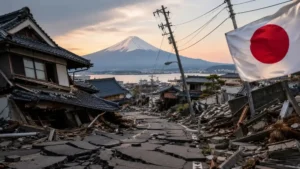
A powerful earthquake in Kumamoto has once again drawn global attention to Japan’s seismic landscape. Here’s why earthquakes occur so frequently in the country, how Japan has built one of the world’s strongest disaster preparedness systems, and the precautions everyone should know.
A powerful 7.1 magnitude earthquake struck Japan’s Kumamoto Prefecture on July 28, damaging infrastructure, disrupting transport services and prompting large-scale rescue operations. The latest Japan earthquake has once again drawn global attention to the country’s constant struggle with seismic activity. Situated on the Pacific Ring of Fire, Japan experiences thousands of earthquakes every year, making disaster preparedness an essential part of everyday life.
While earthquakes of this magnitude make global headlines, they are not unusual for Japan. The country sits in one of the most active seismic zones on Earth and has spent decades strengthening buildings, improving emergency response systems and educating citizens about disaster preparedness.
Understanding why Japan experiences frequent earthquakes provides valuable insight into both the country’s geography and its remarkable resilience.
What happened in the latest Japan earthquake?
The earthquake struck Kumamoto Prefecture in southwestern Japan on July 28, causing widespread damage across several parts of Kyushu. Rescue teams, firefighters, police personnel and Japan’s Self-Defense Forces were deployed to search collapsed buildings like explosion at Aeon Mall and assist affected residents.
Transport services, including some railway operations and airport services, were disrupted. Thousands of households experienced power outages, while emergency shelters were opened for displaced residents. Japanese officials are continuously warning citizens about the possibility of strong aftershocks and landslides, particularly in areas where the ground has already been weakened.
Why are earthquakes so common in Japan?
The main reason behind frequent Japan earthquake events is the country’s unique geographical location.
Japan lies on the Pacific Ring of Fire, a horseshoe-shaped region surrounding the Pacific Ocean that experiences nearly 90 percent of the world’s earthquakes. Multiple tectonic plates meet beneath and around Japan, including:
- Pacific Plate
- Philippine Sea Plate
- Eurasian Plate
- North American (or Okhotsk) Plate
These massive plates constantly move against one another. Sometimes they collide, sometimes they slide past each other, and sometimes one plate sinks beneath another through a process known as subduction. The enormous pressure generated underground eventually gets released as earthquakes.
This geological setting means Japan experiences thousands of earthquakes every year. Most are too small to be felt, but several moderate or powerful earthquakes occur annually.
Japan has lived with earthquakes for centuries
Earthquakes have shaped Japanese history for hundreds of years.
Major disasters, including the 1923 Great Kanto Earthquake, the 1995 Kobe Earthquake, the 2011 Great East Japan Earthquake and Tsunami, the 2016 Kumamoto earthquakes, and the recent Kumamoto earthquake have continually influenced the country’s approach to urban planning, engineering and disaster management. JMA initially issued a tsunami advisory for parts of Kyushu after the earthquake before later lifting it.
Each major event has led to stricter building regulations and improved emergency planning.
How Japan prepares for earthquakes
Despite experiencing frequent earthquakes, Japan is widely regarded as one of the world’s best-prepared countries for seismic disasters.
Earthquake-resistant buildings
Modern Japanese buildings are constructed under strict seismic safety standards.
Engineers use flexible foundations, dampers and shock-absorbing technologies that allow structures to sway safely during earthquakes instead of collapsing.
Many older buildings have also undergone seismic retrofitting.
Early warning systems
Japan operates one of the world’s most advanced earthquake early warning networks.
Sensors installed across the country detect primary seismic waves and automatically send alerts seconds before stronger shaking begins.
These warnings reach:
- Mobile phones
- Television channels
- Radio stations
- Railway systems
- Factories
- Schools
Even a few seconds of warning can help people move to safer locations.
Regular disaster drills
Earthquake preparedness has become an integral part of everyday life in Japan.
Further, schools, offices, government departments and communities in Japan conduct regular evacuation drills to ensure people know how to respond during emergencies.
Many children learn earthquake safety from an early age.
Strict emergency planning
Local governments maintain evacuation shelters stocked with food, drinking water, medicines and emergency supplies.
Authorities also regularly update hazard maps showing areas vulnerable to earthquakes, tsunamis and landslides.
What precautions should people take during an earthquake?
Although earthquakes cannot be prevented, following safety guidelines can significantly reduce the risk of injury.
If indoors
- Stay calm and avoid running.
- Drop to the ground, take cover under a sturdy table or desk, and hold on.
- Protect your head and neck.
- Stay away from windows, mirrors and heavy furniture.
- Do not use elevators.
If outdoors
- Move away from buildings, trees, electric poles and bridges.
- Stay in an open area until the shaking stops.
- Watch for falling glass, debris and signboards.
If driving
- Slow down safely.
- Stop away from bridges, tunnels and overhead structures.
- Stay inside the vehicle until it is safe to move.
If near the coast
If authorities issue a tsunami warning after a major earthquake, move immediately to higher ground without waiting for visible waves.
You might like to read: Priti Patel on Nirav Modi extradition: Why the UK delay angered India and what happened next
How to prepare before an earthquake
Experts recommend keeping an emergency kit ready at all times. A basic kit should include:
- Drinking water
- Non-perishable food
- Flashlight
- Batteries
- First aid supplies
- Essential medicines
- Power bank
- Important documents
- Emergency contact numbers
Families are encouraged to discuss evacuation routes and identify safe meeting points in advance.
Can earthquakes be predicted?
Scientists can identify regions where earthquakes are likely because of tectonic activity, but they cannot accurately predict the exact date, time or magnitude of an earthquake.
Instead, countries such as Japan focus on monitoring seismic activity, improving early warning technology and strengthening infrastructure to minimise loss of life.
What the latest Japan earthquake reminds the world
The recent Japan earthquake is another reminder that natural disasters can strike without warning. While earthquakes remain an unavoidable part of Japan’s geography, decades of investment in engineering, public awareness and emergency preparedness have helped reduce their impact.
For travellers and residents alike, understanding earthquake safety measures and following official guidance remain the most effective ways to stay safe during seismic emergencies.

