
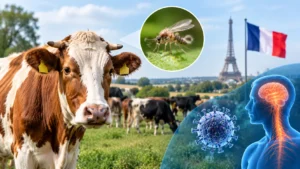
France has reported the first documented human infection. Here is what the case reveals about animal transmission, human health and the risk to India.
The first documented human infection with the Shamonda virus has been reported in France, where a severely immunocompromised patient died in early October 2026. French health authorities are investigating how the patient acquired the infection and whether the virus contributed to the death. The European Centre for Disease Prevention and Control (ECDC) says it is monitoring the situation, while French authorities have reported no identified health risk to the general population based on current knowledge.
For Indian readers, the key question is whether this case signals a wider health threat. The available evidence does not establish a human outbreak in India or sustained transmission between people. However, the case has prompted fresh questions about a virus previously known to affect animals and the need to monitor infections across human and animal populations.
Shamonda Virus Case in France: What Happened?
French authorities announced the first documented human infection on October 22, 2026. The patient had a serious underlying illness, was severely immunocompromised and was receiving treatment at a hospital in Lyon.
The patient died earlier in October. According to France’s National Institute of Health and Medical Research (Inserm), neurological complications observed before the death were considered very likely to be associated with the infection. Investigations into the clinical circumstances, transmission route and virus’s contribution to the death are continuing.
Authorities suspect that an infected Culicoides midge may have transmitted the virus to the patient in eastern France, where it had circulated among animals. However, the precise route has not been confirmed, and the specific midge species involved remains unknown.
Timeline of the Shamonda Virus Case
| Period | What happened |
| 1965 | The virus was first isolated from cattle in Nigeria. |
| Summer 2026 | The virus was detected in European farm animals for the first time. |
| Early October 2026 | The patient in France died after developing an infection. |
| October 22, 2026 | French authorities announced the first documented human infection. |
| October 23, 2026 | The case remains under investigation, with ECDC monitoring developments. |
This timeline shows why the animal detections matter. The human case followed the virus’s emergence in European livestock, although the available evidence does not establish exactly how or when the patient became infected.
What Is the Shamonda Virus?
The Shamonda virus belongs to the Orthobunyavirus genus and Peribunyaviridae family. It is part of the Simbu serogroup, which also includes the Schmallenberg virus, known for causing reproductive problems in livestock.
The virus is primarily associated with cattle, but infections have also been reported in sheep, goats, horses and alpacas. It has been identified in parts of Africa and Asia, and its detection in European livestock in 2026 has increased attention on its distribution and effects.
According to the World Organisation for Animal Health (WOAH), the virus can cause fever, diarrhoea, reduced milk production and reproductive problems in animals, including abortions and foetal malformations. Some animals have also shown neurological signs.
These symptoms can resemble those caused by other diseases. Laboratory testing is therefore needed to confirm an infection rather than relying on visible signs alone.
How Does the Virus Spread?
The Shamonda virus is understood to spread mainly through bites from infected Culicoides midges. These small, biting insects can transmit the virus between susceptible animals.
The suspected insect-bite route in the French human case is an important lead, but it remains unconfirmed. Scientists also have not established whether the virus can spread between humans or how frequently human infections might occur.
ECDC notes that biting midges in Europe are generally more active from spring to autumn, although their activity varies by species, location and weather. Their activity typically declines as temperatures cool.
This seasonal information helps explain why insect surveillance is relevant to animal-health investigations in Europe. It should not be interpreted as evidence that the virus poses a seasonal human threat in India.
Can the Shamonda Virus Cause Severe Illness in Humans?
The French case establishes that human infection is possible, but it does not reveal how the virus usually affects people.
The patient had a serious underlying illness and severe immunosuppression. Investigators are examining the relationship between the infection, the neurological complications and the death. One case cannot establish a human fatality rate or determine whether otherwise healthy people would experience similar complications.
There is also insufficient evidence to establish a typical incubation period, a complete list of human symptoms or the likelihood of severe disease.
No established, specific antiviral treatment for human infection has been demonstrated in the available information. WOAH also reports that no commercially available vaccine for animals is currently available.
Anyone who is concerned about a possible infection should consult a qualified medical professional rather than self-medicate. Treatments used for related viruses should not be assumed to work against this one.
Why This Case Matters for Public Health
The importance of the French case lies in the new evidence of human infection, not proof of a widespread outbreak.
For decades, the virus had been identified in animals without documented human infections. The French case means researchers must investigate how the infection occurred, whether other cases have gone undetected and what factors may have made the patient more susceptible.
It also demonstrates the value of a One Health approach. This means examining human health, animal health and environmental factors together rather than treating them as separate issues.
In practical terms, veterinarians may detect unusual illness in livestock, laboratories may identify the virus, and public-health authorities may then assess whether those findings have implications for people. Sharing information between these groups can help authorities investigate potential risks more effectively.
However, the current evidence does not establish sustained human-to-human transmission. The case should not be interpreted as confirmation that the virus is becoming a common human disease.
Has the Shamonda Virus Reached India?
As of October 23, 2026, the official reports reviewed for this article do not establish a confirmed human case in India. This does not prove that the virus is absent from the country or settle whether it has circulated in Indian animals.
The virus has previously been identified in parts of Asia, but that alone does not confirm its presence in India. Assessing any potential risk would require reliable information about animal infections, the presence of suitable insect vectors and local surveillance findings.
For now, the available evidence does not establish a human outbreak in India. There is no basis in the sources reviewed to suggest that the French case alone represents an immediate public-health emergency for Indian residents.
The most useful response is proportionate monitoring rather than panic. Veterinary authorities can watch for unusual illness in livestock, while public-health agencies can assess new evidence if it emerges.
What Should People and Farmers Do?
The limited evidence about human infection means precautions should focus on general insect protection and animal-health monitoring.
- For the public: Use suitable insect repellents and protective clothing where biting midges are present. Follow local health advice if authorities issue specific guidance.
- For farmers: Watch cattle and other livestock for fever, diarrhoea, reduced milk production and reproductive problems.
- For veterinarians: Arrange appropriate laboratory testing when unusual symptoms warrant investigation.
- For animal transport: Follow veterinary advice on insect control and measures to reduce exposure.
- For authorities: Share relevant findings across animal-health and public-health systems.
These are general precautions, not evidence that a human outbreak is occurring. Farmers should seek veterinary advice rather than assume that symptoms in livestock are caused by the Shamonda virus.
Know more about Shamonda Virus:
Can the virus spread from one person to another?
There is no established evidence of sustained human-to-human transmission. The first documented human case is still being investigated, and more evidence is needed to understand how infection occurs.
Is the Shamonda virus always fatal?
No. The death of the first documented patient does not establish that the infection is generally fatal. The patient had a serious underlying illness and severe immunosuppression, and the virus’s contribution to the death remains under investigation.
Should people in India be worried?
The official reports reviewed for this article do not establish a confirmed human case in India. Current evidence does not justify panic, although monitoring animal infections and reviewing new scientific findings remain important.
Can people get infected by eating meat or drinking milk?
The available evidence does not establish food consumption as a transmission route. Follow normal food-safety practices and official veterinary and food-safety guidance.
What do scientists still need to find out?
Investigators need to clarify how the French patient acquired the infection, whether the virus directly contributed to the death, how it affects humans and whether other human infections have occurred undetected.
What Happens Next?
The first documented human Shamonda virus infection in France is a new scientific and public-health finding, but it is not evidence of a widespread human epidemic. Investigations by French authorities and ECDC are continuing to establish how the infection occurred and what it means for human and animal health.
Further clinical, laboratory and epidemiological evidence will help clarify the virus’s effects in people. Until more information becomes available, continued surveillance and proportionate precautions remain the appropriate response.
You may like to read: India Caps Trade Margins at 30% on 137 Cancer Drugs, New Prices From November 9

