
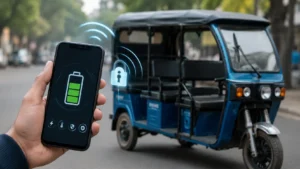
Reports of BAT-BMS App misuse have sparked concerns over e-rickshaw safety, Bluetooth-enabled battery security, and the need for stronger authentication in connected EV systems.
The BAT-BMS App, a battery management application designed to monitor compatible lithium-ion batteries, has come under public scrutiny after viral videos appeared to show individuals remotely stopping certain moving e-rickshaws using the app. The clips, widely shared on social media, have prompted discussions about battery security, connected vehicle safety, and the risks of leaving Bluetooth-enabled battery management systems unsecured. While the videos have alarmed many users, experts say the issue is more limited than many online claims suggest and does not affect all electric vehicles.
What is the BAT-BMS App?
The BAT-BMS App is a battery management system (BMS) application developed to help users monitor compatible Bluetooth-enabled lithium batteries. It displays battery information such as charge level, voltage, current, temperature, cycle count, and cell health. On compatible battery systems, it also allows users to manage charging and discharging functions.
The application itself is intended for legitimate battery monitoring and management. However, recent reports suggest that some people have attempted to misuse its control functions where compatible battery management systems lack adequate security measures.
Why are videos of e-rickshaws stopping going viral?
The controversy began after several videos circulated on social media showing people apparently connecting to nearby e-rickshaws through the BAT-BMS App and causing the vehicles to lose power while moving. According to multiple media reports, the videos have raised concerns among drivers and passengers, particularly because an unexpected loss of power on busy roads could create safety risks.
However, experts caution that the viral clips do not mean every electric vehicle or every e-rickshaw is vulnerable. The reported issue appears to involve only certain Bluetooth-enabled lithium battery packs using compatible battery management systems that have not been properly secured.
How can the app affect certain e-rickshaws?
Technology experts explain that the issue is not a case of sophisticated hacking but rather a security configuration problem affecting some battery systems.
Many low-cost lithium battery packs used in some e-rickshaws include Bluetooth-enabled battery management systems (BMS). If these systems are left without password protection or other authentication safeguards, someone within Bluetooth range—typically around 10 to 15 metres—may be able to connect using a compatible application.
If access is obtained, the user may be able to disable the battery’s discharge output on compatible systems. Since the discharge function supplies power to the vehicle’s motor, switching it off can temporarily stop the e-rickshaw. Experts say this is possible only when several technical conditions are met, including compatibility between the battery management system and the application, as well as inadequate security settings on the battery pack.
Are all electric vehicles at risk?
No. Experts and technology reports indicate that the issue is limited to certain battery configurations rather than the entire electric vehicle ecosystem.
Vehicles powered by traditional lead-acid batteries are not affected because they do not use Bluetooth-enabled battery management systems. Likewise, many lithium-powered electric vehicles use proprietary battery management software, password-protected systems, or different communication protocols that are not compatible with the BAT-BMS App.
There is currently no official evidence that all electric cars, electric scooters, or e-rickshaws can be remotely controlled using the application. Claims suggesting that any nearby EV can be switched off through the app are considered misleading.
Why does the issue raise safety concerns?
Although the reported vulnerability appears limited, experts say it highlights an important cybersecurity challenge for connected electric mobility.
If a compatible e-rickshaw unexpectedly loses power while travelling, it could increase the risk of traffic disruption or accidents, especially on congested roads. The incident has also drawn attention to the importance of securing battery management systems with proper authentication, encryption, and password protection before vehicles are delivered to customers.
Experts note that the concern lies primarily with unsecured Bluetooth-enabled battery systems rather than with the BAT-BMS App itself, which was designed for legitimate battery monitoring.
You can also read: ‘Built One of India’s Most Important Tech Companies’: Zuckerberg Names Kunal Shah as WhatsApp Chief
What can manufacturers and users do?
Technology experts believe stronger security practices can significantly reduce the risk of unauthorised access.
Suggested measures include:
- Configuring password protection before battery systems are delivered to customers.
- Disabling unrestricted Bluetooth pairing where possible.
- Using stronger authentication for battery management systems.
- Providing software updates where supported.
- Educating dealers and vehicle owners about securing Bluetooth-enabled battery packs.
Experts also note that many e-rickshaw owners may not be familiar with battery security settings, making it important for manufacturers and dealers to configure these protections during installation rather than leaving them to end users.
The broader takeaway
The BAT-BMS App controversy has highlighted the growing importance of cybersecurity as connected technologies become more common in electric mobility. Rather than indicating a widespread weakness across all electric vehicles, the reported incidents point to the need for better security practices in specific Bluetooth-enabled battery management systems.
As India’s EV ecosystem continues to expand, experts say manufacturers, dealers, and battery suppliers will need to place greater emphasis on secure default settings and stronger authentication to minimise the risk of unauthorised access while maintaining the benefits of connected battery monitoring.

