
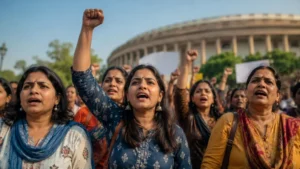
Women’s organisations have urged the Centre to implement the Women’s Reservation Bill at the current strength of Parliament and state legislatures, arguing that the quota should not remain tied to the census and delimitation process
A nationwide coalition of women’s organisations and activists has intensified its demand for the immediate implementation of the Women’s Reservation Bill, urging the Union government to provide one-third reservation for women in Parliament and state legislative assemblies without linking it to the census and delimitation exercise.
Ahead of the upcoming Monsoon Session of Parliament, the group, operating under the banner of the National Coalition for Women’s Reservation, announced that it will launch nationwide protests beginning July 20 to press for its demands. The coalition maintains that the constitutional provision for women’s reservation should be enforced based on the existing strength of Parliament and state legislatures, instead of waiting for future delimitation.
Coalition seeks immediate implementation of Women’s Reservation Bill
The coalition has called for the unconditional and immediate implementation of the 33% reservation for women from the next round of elections. According to the activists, the reservation should be operational without making it dependent on the completion of the national census and the subsequent delimitation process.
Representatives of the coalition argue that delaying the implementation would postpone greater political representation for women, despite Parliament already approving the constitutional amendment providing for the reservation.
Why is delimitation at the centre of the debate?
The Women’s Reservation Bill, enacted through the Constitution (One Hundred and Sixth Amendment) Act, provides for reserving one-third of seats in the Lok Sabha and state legislative assemblies for women. However, the law specifies that the reservation will come into effect only after the first census conducted following the commencement of the Act and a subsequent delimitation exercise.
Women’s organisations contend that this condition has delayed the implementation of the reservation and are therefore demanding that the quota be delinked from these processes so that it can be introduced using the current number of seats.
Nationwide protests to begin from July 20
To build public support for their demand, the coalition has announced a nationwide campaign starting July 20, coinciding with the beginning of the Monsoon Session of Parliament. The organisations plan to hold demonstrations and public outreach programmes across different parts of the country, calling on the government to ensure that women receive one-third representation in legislatures without further delay.
What is the coalition demanding?
The key demands raised by the National Coalition for Women’s Reservation include:
- Immediate implementation of the 33% reservation for women in Parliament and state legislatures.
- Delinking the reservation from the census and delimitation process.
- Implementing the quota based on the current strength of the Lok Sabha and state Assemblies.
- Bringing the reservation into effect from the next round of elections.
How greater representation can shape legislative participation
Women’s representation in legislatures is closely connected with the broader question of who participates in political decision-making. A higher presence of women in elected bodies can bring a wider range of experiences and perspectives into legislative discussions, particularly on issues affecting families, education, public services, employment and community welfare.
The reservation framework seeks to address the long-standing imbalance in the participation of women in elected institutions. Supporters of the measure view a constitutional quota as a way of creating a defined space for women within representative politics rather than relying only on gradual changes in electoral participation.
The debate is therefore not limited to the percentage of seats reserved. It also concerns how political institutions can become more representative of the population they serve and how women from different social and regional backgrounds can gain opportunities to participate in lawmaking.
What implementation could mean for Indian politics
The implementation of the constitutional provision would mark a major change in the composition of elected legislatures. Its eventual operation would introduce a formal reservation framework for women at the national and state legislative levels, while the specific allocation of reserved constituencies would be determined under the constitutional mechanism provided by the law.
The issue also demonstrates the connection between constitutional amendments and the processes required to put their provisions into effect. Passing legislation and implementing it can involve additional procedural stages, particularly when seat allocation and constituency boundaries are involved.
For voters, political parties and aspiring candidates, the timing and mechanism of implementation can therefore have implications beyond the reservation percentage itself. Parties may need to consider how greater participation by women affects candidate selection and internal political structures once the provision becomes operational.
The continuing debate around the Women’s Reservation Bill reflects a wider discussion about representation, electoral institutions and the pace at which constitutional reforms should translate into practical political participation.
Read more: Passport Is a Travel Document, Not Conclusive Proof of Citizenship, Says MEA Official

