
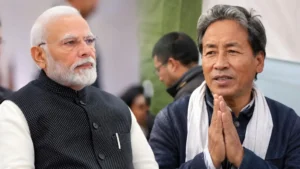
Hours after PM Narendra Modi wished Sonam Wangchuk good health, the activist ended his 26-day hunger strike following the Centre’s written assurances on examination reforms and continued dialogue.
The Sonam Wangchuk hunger strike ends story took a significant turn on Friday after Prime Minister Narendra Modi publicly expressed relief over the activist’s health, saying he was glad to know Wangchuk was healthy and extending his best wishes.
Shortly afterwards, Wangchuk announced the end of his 26-day indefinite hunger strike, saying the decision came after the Central Government provided written assurances on key demands, including discussions on examination reforms, protection for peaceful protesters and continued engagement with student representatives. The breakthrough marks the first major step towards resolving a protest that had drawn nationwide attention over examination accountability and student concerns.
The Sonam Wangchuk hunger strike ends story has drawn nationwide attention because the fast had become a symbol of students’ demands for transparency, accountability and stronger safeguards against examination irregularities. Although Wangchuk has ended his fast, protest groups have indicated that their broader movement for education reforms will continue while monitoring the government’s commitments.
PM Modi responds after Sonam Wangchuk hunger strike ends
Reacting to the development, PM Narendra Modi shared a message on X, saying:
“I am happy to know that Sonam Wangchuk Ji is healthy. I wish him good health and pray that he continues to contribute to our nation with the same passion and dedication.”
The Prime Minister’s message came soon after Wangchuk announced that he was ending his fast following the government’s written assurances. His statement was widely shared as the protest entered a new phase centred on dialogue and implementation of the commitments made by the Centre.
Why did Sonam Wangchuk end his hunger strike?
According to Wangchuk, the decision was taken after the Centre provided written assurances on multiple issues raised during the protests. Union Health Minister J.P. Nadda and Minister of State in the Prime Minister’s Office Dr Jitendra Singh met Wangchuk at Medanta Hospital in Gurugram before the fast concluded.
Among the assurances reportedly given by the government are:
- A parliamentary discussion on examination accountability and paper leak issues.
- Continued dialogue with student representatives.
- No punitive action against peaceful protesters.
- Consideration of compensation and support measures for families affected by examination-related incidents.
- Continued efforts to strengthen reforms aimed at preventing future examination irregularities.
PM Modi announces tougher anti-paper leak measures
The development comes shortly after Prime Minister Narendra Modi announced that the government would move ahead with stricter measures against examination fraud. In a public statement, the Prime Minister said the Centre would introduce a stronger anti-paper leak framework with tougher punishments and fast-track mechanisms to deal with such offences, while reaffirming the government’s commitment to protecting the interests of students.
What did Sonam Wangchuk say?
After ending his fast, Wangchuk said the written assurances played a decisive role in his decision. He stated that the movement had always focused on accountability, peaceful dialogue and protecting the interests of students rather than confrontation. He also indicated that the assurances created an opportunity for constructive discussions while urging supporters to remain peaceful.
Will the protests continue?
Although the Sonam Wangchuk hunger strike ends chapter has concluded, organisers have clarified that the larger campaign is not over. Student groups and protest organisers have said demonstrations and public engagement will continue until the promised reforms are implemented and commitments are translated into policy decisions.
Government representatives have maintained that discussions with stakeholders will continue and that the proposed reforms are intended to restore public confidence in India’s examination system.
Why was the hunger strike significant?
The hunger strike became one of the most prominent public campaigns demanding accountability over alleged examination irregularities. Wangchuk’s protest attracted support from students, education activists and civil society groups across several states, prompting discussions between the government and protest representatives.

