
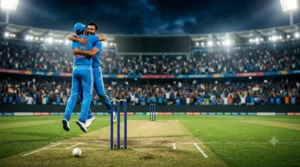
Virat Kohli’s 74-run knock helped India chase a revised target of 143 in Auckland, but Anshul Kamboj earned the Player of the Match award with two wickets, 46 dot balls and an economy rate of 2.20. Shubman Gill also praised India’s collective bowling and fielding effort.
India opened its five-match ODI campaign in Auckland on November 4, 2026, with a convincing five-wicket win over New Zealand at Eden Park. Virat Kohli scored a fluent 74 off 51 balls to guide the revised chase, while Anshul Kamboj earned Player of the Match honours for his disciplined bowling.
The India vs New Zealand 1st ODI 2026 also showcased the strength of India’s pace attack. Arshdeep Singh claimed four wickets, Gurnoor Brar took three, and Kamboj picked up two wickets while conceding only 22 runs in his 10 overs.
New Zealand managed 185 runs in 40.2 overs. Rain interruptions later reduced India’s target to 143 runs in 32 overs under the Duckworth-Lewis-Stern (DLS) method. India reached the revised target in 22.4 overs, securing a five-wicket win and moving ahead in the series with a 1-0 advantage.
India vs New Zealand 1st ODI 2026 – Why Did Kamboj Win Player of the Match?
Anshul Kamboj’s performance stood out because of his control over the scoring rate. Although Arshdeep Singh took four wickets and Gurnoor Brar claimed three, Kamboj made it difficult for New Zealand’s batters to score freely.
The right-arm pacer finished with figures of 2/22 in 10 overs. His spell included two maiden overs and 46 dot balls, giving him an economy rate of just 2.20 runs per over.
Kamboj sent New Zealand captain Mitchell Santner and Nathan Smith back to the pavilion with two important breakthroughs. He maintained consistent line and length and used his wobble-seam delivery effectively to trouble the batters.
During the post-match presentation, Kamboj explained that sticking to the basics helped him deliver the performance. He said maintaining consistent line and length was his main focus. He also credited the wobble-seam delivery for working well on the Auckland surface.
His figures showed how a bowler can influence an ODI innings through pressure and accuracy, even without taking the highest number of wickets.
What Did Shubman Gill Say After India’s Victory?
India captain Shubman Gill praised the team’s bowling and fielding efforts during the post-match presentation.
He said:
“We were very good with the bowling. And I think our fielding was also really good.”
Gill also appreciated the performances of Kamboj and Gurnoor Brar. He described their bowling as magnificent and said Kamboj was well suited to the conditions.
The captain also mentioned Rohit Sharma’s involvement in Daryl Mitchell’s run-out. According to Gill, that dismissal changed the momentum of the match.
His comments reflected India’s collective effort rather than focusing on one individual performance.
How Did India’s Bowlers Restrict New Zealand to 185?
India opted to field first after winning the toss, putting New Zealand in to bat. Arshdeep Singh gave the visitors an early advantage by dismissing Will Young and Henry Nicholls.
Both batters scored nine runs each, leaving New Zealand at 40/2.
Tim Seifert tried to stabilise the innings with 38 runs from 43 deliveries. Daryl Mitchell added 28 runs, while Glenn Phillips contributed 30. However, New Zealand struggled to build a substantial partnership.
Gurnoor Brar produced an impressive spell of 3/44 in 9.2 overs. His pace and bounce troubled the batters, and he dismissed captain Tom Latham with a sharp return catch.
Arshdeep finished with four wickets for 70 runs in 10 overs. Kamboj supported the attack with his economical spell and two important wickets.
Blair Tickner provided some late resistance with 34 runs from 23 balls, including four sixes. However, the Indian bowlers eventually dismissed New Zealand for 185 in 40.2 overs.
India vs New Zealand 1st ODI 2026 – How Did Kohli and Gill Guide the Chase?
India’s chase suffered an early setback when Rohit Sharma departed for a six-ball duck. Kyle Jamieson dismissed the Indian opener in the first over.
Kohli joined Gill at the crease and helped India recover. The two batters added 114 runs for the second wicket, giving the visitors a strong position in the chase.
Kohli scored 74 off 51 deliveries, including 13 fours and one six. He also registered his 80th ODI half-century during the innings.
Gill contributed 37 runs from 56 balls. His steady batting allowed Kohli to play his attacking shots while keeping India’s required run rate under control.
Rain interrupted the chase twice, forcing a revision of the target. Despite the disruptions, Kohli continued to guide the innings until Jacob Duffy dismissed him.
Duffy also removed Axar Patel and Shreyas Iyer, finishing with figures of 3/49. However, India maintained their advantage and reached 143/5 in 22.4 overs. Naman Dhir struck the winning boundary to complete the five-wicket victory.
How Did India’s Fielding Contribute to the Win?
India’s fielding effort also played a part in restricting New Zealand.
Rohit Sharma and KL Rahul combined to run out Daryl Mitchell, who had scored 28 runs. Gill later identified this dismissal as an important moment in the match.
Kohli also made an impact in the field by taking a catch to dismiss Nathan Smith off Kamboj’s bowling.
These contributions supported the bowlers and prevented New Zealand from building a stronger total.
Why Does Anshul Kamboj’s Bowling Performance Matter?
Kamboj’s spell demonstrated the importance of controlling runs in limited-overs cricket. His 46 dot balls restricted New Zealand’s scoring opportunities and put pressure on the batters to take risks.
While Arshdeep and Brar provided breakthroughs, Kamboj maintained pressure from the other end. His economy rate of 2.20 also helped India control the middle and later stages of the innings.
For India, the performance offered another positive sign from their pace attack. Kamboj’s contribution showed that taking wickets and restricting runs can be equally valuable in an ODI match.
India vs New Zealand 1st ODI 2026 Scorecard
| Match details | Score |
| New Zealand | 185 all out (40.2 overs) |
| India | 143/5 (22.4 overs) |
| Revised target | 143 in 32 overs |
| Virat Kohli | 74 (51 balls) |
| Shubman Gill | 37 (56 balls) |
| Tim Seifert | 38 (43 balls) |
| Arshdeep Singh | 4/70 |
| Gurnoor Brar | 3/44 |
| Anshul Kamboj | 2/22 |
| Jacob Duffy | 3/49 |
| Player of the Match | Anshul Kamboj |
| Result | India won by 5 wickets (DLS) |
What Is Next for India and New Zealand?
India’s opening victory gives the team a 1-0 advantage in the five-match ODI series. The second match is scheduled for November 7, 2026, in Wellington.
New Zealand will look to improve its batting performance after being dismissed for 185 in Auckland. Captain Mitchell Santner also acknowledged after the match that his team had not adapted quickly enough to the conditions.
India, meanwhile, will look to maintain the bowling discipline and batting consistency they showed in the opening match.
The India vs New Zealand 1st ODI 2026 was a reminder that a strong team performance involves more than individual batting or bowling figures. Kohli provided stability with the bat, while Kamboj, Arshdeep and Brar helped India take control through the ball.
Kamboj’s economical spell, in particular, gave the visitors another reason to be pleased with their opening performance.
Read more: Why Does Pakistan Dominate India in Hong Kong Sixes? The 4-1 Record Explained

