
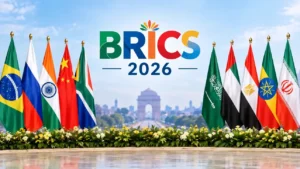
India uses the BRICS platform to push its concerns on terrorism and global governance while leaders gather in New Delhi amid major geopolitical tensions.
The BRICS Summit 2026 has brought some of the world’s most influential emerging economies to New Delhi at a time when wars, trade disputes and shifting global alliances are reshaping international relations. With Prime Minister Narendra Modi hosting the summit, the presence of Russian President Vladimir Putin and Chinese President Xi Jinping has added further diplomatic weight to the gathering.
Beyond the high-profile meetings, the summit has placed several issues of direct global importance on the table, including terrorism, international trade, conflicts and reforms in global institutions. The adoption of the New Delhi Declaration has given particular attention to terrorism, with BRICS members strongly condemning the April 22, 2025 Pahalgam terror attack that killed 26 people.
For India, the BRICS Summit 2026 is also an opportunity to put its concerns before a wider international grouping while strengthening cooperation with BRICS members across economic, diplomatic and development-related areas.
BRICS Summit 2026 focuses on global challenges
India is holding the 18th BRICS Summit during its fourth chairship of the grouping. The official theme for India’s 2026 chairship is “Building for Resilience, Innovation, Cooperation and Sustainability.”
The summit’s agenda covers several areas, including economic cooperation, sustainable development, technology, international trade, global governance and geopolitical challenges.
The New Delhi Declaration calls for disputes to be addressed through dialogue, consultation and diplomacy. BRICS leaders have also raised concerns about unilateral tariff and non-tariff measures that can affect international trade.
The discussions are taking place as BRICS attempts to strengthen cooperation among countries with different political and economic systems while giving greater representation to the Global South.
BRICS countries condemn Pahalgam terror attack
Terrorism has emerged as one of the major issues in the BRICS Summit 2026.
The New Delhi Declaration strongly condemns the April 2025 Pahalgam terror attack in Jammu and Kashmir, in which 26 people were killed. The members reaffirmed their commitment to a policy of zero tolerance towards terrorism in all its forms and manifestations.
The declaration also stresses the need for international cooperation to tackle terrorist financing and safe havens. It supports action against terrorist organisations designated by the United Nations and calls for progress towards a Comprehensive Convention on International Terrorism under the UN framework.
The declaration does not name Pakistan in its reference to the Pahalgam attack. However, the inclusion of the attack in a joint BRICS document places India’s concerns about terrorism within a wider multilateral discussion.
Modi holds meeting with Putin
The summit has also provided an opportunity for India to engage with key partners, including Russia and China.
Prime Minister Narendra Modi met Russian President Vladimir Putin on the sidelines of the BRICS Summit 2026. According to the Prime Minister’s Office, the two leaders reviewed bilateral cooperation covering political, economic, defence, energy, space, skill mobility and people-to-people ties. They also discussed India-Russia engagement within BRICS under India’s 2026 chairship.
The presence of Chinese President Xi Jinping is also important for the BRICS Summit 2026, as India continues to engage with China on both bilateral and multilateral platforms.
With Russia and China among the major BRICS members, the summit gives India an opportunity to maintain dialogue with both countries while pursuing its wider economic and diplomatic priorities.
Why was BRICS formed?
BRICS began as a grouping of major emerging economies. The original grouping comprised Brazil, Russia, India and China, with South Africa joining later.
The first BRIC leaders’ summit was held in 2009, while South Africa joined the grouping in 2011, creating BRICS.
The grouping has since expanded substantially. According to the Indian government’s BRICS information, the bloc now has 11 members — Brazil, China, Egypt, Ethiopia, India, Indonesia, Iran, Russia, Saudi Arabia, South Africa and the United Arab Emirates.
The expansion has increased BRICS’ geographic and economic reach and strengthened its role as a platform for cooperation among emerging and developing economies.
What does BRICS do?
BRICS is not a military alliance. Its activities cover areas such as economic cooperation, trade, finance, technology, health, agriculture, sustainable development and people-to-people exchanges.
The grouping has also pushed for greater representation of developing countries in international institutions, including the United Nations and global financial institutions.
The New Development Bank, established by BRICS, is another major institutional initiative. It focuses on mobilising resources for infrastructure and sustainable development projects in member and other developing countries.
Why BRICS matters for India
For India, BRICS provides a platform to engage with several major economies at the same time.
The grouping includes countries such as Russia, China, Iran, the UAE, Brazil and South Africa, giving India an opportunity to discuss issues that extend beyond bilateral relations.
India has also used its BRICS chairship to promote cooperation around resilience, innovation, sustainability and development. The government’s stated objective is to strengthen BRICS as a constructive and solutions-oriented forum while giving greater attention to the aspirations of the Global South.
At the same time, BRICS includes countries with different foreign policy priorities and relationships with Western powers. Reaching consensus on sensitive geopolitical issues can therefore be challenging.
What the New Delhi Declaration means
The BRICS Summit 2026 has produced a joint declaration covering several major international issues.
The statement calls for diplomacy and dialogue in resolving conflicts, expresses concern over escalating tensions in West Asia and raises concerns about unilateral trade measures. It also addresses terrorism and the need for greater international cooperation against terrorist financing and safe havens.
For India, the condemnation of the Pahalgam attack is an important part of the declaration. It gives New Delhi a multilateral platform to reinforce its position on terrorism while continuing engagement with countries that have different strategic interests.
The summit therefore reflects the wider role India wants BRICS Summit 2026 to play — not only as an economic grouping, but also as a forum for discussing global security, development, trade and reforms in international institutions.
You may like to read: Stock market crash or correction? Why Iran conflict is pressuring Sensex and Nifty
Check latest updates about the BRICS Summit 2026 here:

