
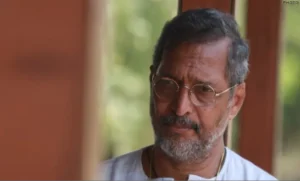
Few actors have moved between serious drama and mainstream entertainment with the same ease. Nana Patekar built that rare versatility over five decades, leaving behind performances that continue to connect with audiences.
Nana Patekar, one of Indian cinema’s most recognisable actors, died at the age of 75 on October 8, 2026, after suffering cardiac arrest in Goa. The actor was found unconscious at his residence and taken to Manipal Hospital, where doctors could not revive him.
His death brings an end to a career spanning nearly five decades across Hindi and Marathi cinema, theatre and filmmaking. From intense dramatic roles in Parinda and Krantiveer to his popular comic performance in Welcome and his acclaimed work in Natsamrat, Patekar built a filmography that crossed genres and generations.
Nana Patekar dies at 75 after cardiac arrest
Patekar was found unconscious at his Goa residence and was subsequently taken to Manipal Hospital. Doctors attempted to revive him, but he could not be saved. Cardiac arrest was reported as the cause of death.
Born Vishwanath Patekar on January 1, 1951, in Maharashtra, he began his artistic journey through Marathi theatre before entering films. His film debut came with Gaman in 1978.
Over the following decades, Patekar worked across Hindi and Marathi cinema while continuing to maintain his association with theatre and filmmaking. Unlike actors who remained closely identified with conventional leading roles, he frequently moved between protagonists, antagonists and supporting characters.
Why Nana Patekar’s death matters to Indian cinema
Patekar’s career represented a different route to recognition in mainstream Indian cinema. His reputation developed through acting ability, theatre experience and character-driven performances rather than depending only on conventional hero roles.
His work also connected different parts of Indian cinema. He appeared in Hindi films that reached a nationwide audience while continuing to work in Marathi productions, including Natsamrat. His theatre background remained an important part of his artistic identity.
That range is one reason his filmography includes serious dramas, action films, political stories and mainstream comedies. His performances could change considerably from one project to another while his distinctive voice and dialogue delivery remained recognisable.
From theatre to films, a career spanning nearly five decades
Patekar’s career can be traced through several important stages:
| Year | Career milestone |
| 1978 | Made his film debut with Gaman |
| 1989 | Appeared in Parinda |
| 1991 | Directed Prahaar: The Final Attack |
| 1994 | Starred in Krantiveer |
| 2007 | Played Uday Shetty in Welcome |
| 2013 | Received the Padma Shri |
| 2016 | Starred in Marathi film Natsamrat |
| 2018 | Appeared in Kaala |
| 2026 | Died at the age of 75 |
His early association with theatre helped establish the acting style that later became familiar on screen. Parinda was among the performances that brought him wider recognition, while Krantiveer established him as a leading performer in a powerful dramatic role.
Nana Patekar also directed Prahaar: The Final Attack in 1991, adding filmmaking to his work as an actor and theatre performer.
Which Nana Patekar films remain memorable?
His filmography covers several genres and includes both Hindi and Marathi productions.
Some of his notable films are:
- Gaman (1978)
- Parinda (1989)
- Prahaar: The Final Attack (1991)
- Angaar (1992)
- Tirangaa (1993)
- Krantiveer (1994)
- Agni Sakshi (1996)
- Khamoshi: The Musical (1996)
- Ab Tak Chhappan (2004)
- Apaharan (2005)
- Welcome (2007)
- Raajneeti (2010)
- Welcome Back (2015)
- Natsamrat (2016)
- Kaala (2018)
Patekar’s popular image changed considerably with Welcome. His portrayal of Uday Shetty introduced his intense screen presence to a comic setting and became one of his most recognised commercial roles.
In Marathi cinema, Natsamrat offered another important chapter. Released in 2016, the film centred on a retired theatre actor and gave Patekar a role closely connected with his own background in stage performance.
Three National Film Awards and the Padma Shri
Patekar won three National Film Awards during his career.
He received the Best Supporting Actor award for Parinda, the Best Actor award for Krantiveer and another Best Supporting Actor honour for Agni Sakshi.
The three awards also illustrate the range of roles he took on. He was recognised both for supporting performances and for carrying a leading role.
In 2013, the Government of India awarded Patekar the Padma Shri for his contribution to the arts. He also received Filmfare honours and recognition connected with Marathi cinema.
Patekar’s work beyond films
Patekar’s public life extended beyond acting and filmmaking. He was associated with social initiatives involving farmers and communities affected by drought.
He co-founded the Naam Foundation with actor Makarand Anaspure. The organisation has worked on issues affecting farmers and drought-hit communities.
His social work became another part of his public identity, alongside his career in cinema and theatre. Tributes following his death also referred to contributions he made outside the film industry.
Actors and political leaders pay tribute
Patekar’s death prompted tributes from colleagues and public figures across India.
Rajinikanth, who worked with him in Kaala, remembered the veteran actor following his death. Akshay Kumar also paid tribute to Patekar, with whom he worked in films including Welcome and Housefull 5.
Riteish Deshmukh remembered Patekar on social media, referring to his acting talent and contribution outside cinema. Deshmukh had worked with him in Bluffmaster and Housefull 5.
Jr NTR also paid tribute to the veteran performer, remembering his contribution to Indian cinema.
Prime Minister Narendra Modi expressed condolences following Patekar’s death and remembered his contribution and versatility as an actor.
The tributes reflected Patekar’s reach across different generations and sections of the Indian film industry.
What is Nana Patekar’s legacy?
Patekar leaves behind a career that covered nearly five decades and included three National Film Awards, the Padma Shri, theatre, filmmaking and social work.
His importance to Indian cinema lies not only in the number of films he made but also in the variety of roles he accepted. He moved between serious dramas, action films, political stories, Marathi cinema and mainstream comedy without being restricted to one screen image.
Performances in Parinda, Krantiveer, Agni Sakshi, Ab Tak Chhappan, Welcome and Natsamrat represent different stages of that journey.
His work also created a connection between theatre and cinema for audiences who came to know him primarily through films. That combination of stage experience, character-driven acting and commercial cinema helped make him one of the more distinctive performers of his generation.
At 75, Nana Patekar’s death marks the loss of a veteran actor whose work remained visible across Hindi and Marathi cinema for decades.
What happens next?
Patekar is expected to receive full state honours, according to reports following his death. Further details about his last rites and funeral arrangements are expected from the authorities and his family.
You may like to read: Drishyam 3 is not the story you expect what makes Vijay Salgaonkar’s final chapter different

