
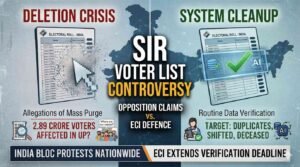
UP’s chief electoral officer says the applications were collected before the draft roll was published. The dispute centres on disclosure requirements and the interpretation of election instructions.
Uttar Pradesh’s UP Form 9 voter list dispute centres on 16.18 lakh Form 6 applications collected before the draft electoral roll was published on January 6, 2026. Chief Electoral Officer (CEO) Navdeep Rinwa has said these applications did not fall under the Form 9 publication requirement. However, an investigation published on October 8 challenged his interpretation, arguing that Election Commission of India (ECI) instructions required details of applications for inclusion to be made public.
The disagreement raises questions about how voter-registration applications are recorded, disclosed and scrutinised during the Special Intensive Revision (SIR). While the CEO has defended the procedure, the issue needs to be assessed against the applicable instructions and official records.c
What is the dispute over 16.18 lakh Form 6 applications?
The controversy concerns applications collected during Uttar Pradesh’s 2026 SIR. According to the CEO, Booth Level Officers (BLOs) collected Form 6 applications during the door-to-door enumeration exercise from October 27, 2025, to January 6, 2026. These applications were intended for eligible citizens whose names were missing from the existing electoral roll.
The CEO says the figure of 16.18 lakh represents applications collected before the draft roll was published, not the number of voters automatically added to the final list. He has rejected allegations of irregularities and maintained that the process followed ECI instructions.
An investigation published on October 8 questioned why the details of these applications had not been made public. It argued that the instructions it examined required applications for inclusion to be submitted during the claims and objections period and their details to be disclosed.
The investigation also reported that the CEO’s explanation contradicted the wording of the documents it examined. These findings represent the investigation’s account and should be assessed against the complete instructions and the election authorities’ response.
What has the UP CEO said about Form 9?
In a clarification reported on October 9, Rinwa said Form 9 lists were required for applications received during the officially notified claims and objections period. He said the period in Uttar Pradesh ran from January 6 to March 6, 2026, and that the relevant lists were published on the CEO’s website.
He maintained that applications collected before January 6 fell outside this publication requirement. He also rejected the suggestion that officials had created a special exemption for Uttar Pradesh.
The investigation disputes this interpretation, saying the instructions it examined did not permit the state to collect these applications before publication of the draft roll and withhold their details from public scrutiny.
The central question in the UP Form 9 voter list controversy is whether the procedure followed during the enumeration phase complied with the instructions applicable to the 2026 SIR. The CEO’s statement and the investigation’s findings represent competing accounts, making the underlying documents important for assessing the dispute.
What are Form 6 and Form 9 used for?
Form 6 allows eligible Indian citizens to apply for inclusion in an electoral roll. Election officials examine applications and determine whether applicants meet the requirements for registration. Submitting Form 6 does not automatically confirm inclusion.
Form 9 is associated with the publication of claims for inclusion during the prescribed claims and objections process. These lists help make applications available for scrutiny under the applicable rules.
Collecting an application, publishing its details, verifying eligibility and approving registration are separate steps. The applicable instructions determine how election officials must handle each stage.
Therefore, the 16.18 lakh figure should not be presented as the final number of voters added without records confirming the approval outcomes.
Why have 42 former judges defended the ECI?
The dispute has emerged amid a wider national debate over the ECI, electoral-roll revisions and allegations of irregularities. On October 8, an open letter signed by 42 former judges drew attention to their defence of the Commission and their criticism of what they described as a politically motivated campaign against constitutional institutions.
The signatories expressed concern about attacks on the Chief Election Commissioner and other constitutional bodies. They argued that unsupported allegations could weaken public confidence in democratic institutions and defended the ECI’s authority to conduct the SIR.
Their position adds another perspective to the debate. Allegations against election officials should be supported by evidence, while criticism of constitutional institutions should distinguish documented concerns from political claims.
However, the letter does not directly resolve the UP Form 9 voter list dispute. The former judges’ defence of the ECI is a position on the wider controversy, not independent verification that the specific disclosure requirements were followed in Uttar Pradesh.
The two issues should be assessed separately. Official explanations and allegations both need to be examined against the rules and records relevant to the case.
Why does the dispute matter for voters?
Electoral rolls determine who can exercise the right to vote. If an eligible citizen’s name is missing, that person may need to apply for inclusion and follow the prescribed verification process. Accurate records also help election officials identify errors and maintain reliable voter lists.
Public disclosure allows interested citizens and political parties to scrutinise claims and raise objections through the prescribed process. Clear rules and accessible records help people understand how registration decisions are made.
The UP Form 9 voter list issue raises questions about whether the applicable instructions required details of the 16.18 lakh applications to be published and whether the process followed met those requirements. Neither the application count nor the existence of a disagreement establishes that individual registrations were improper.
What happens next?
A clearer assessment requires examining the complete ECI instructions applicable to the 2026 SIR, the UP CEO’s written clarification and the relevant application and publication records.
Voters can check their registration status through the ECI voter services portal and use the prescribed channels to apply for inclusion or correction where necessary.
The dispute concerns both procedure and public accountability. The CEO has defended the process, an investigation has challenged his interpretation of the disclosure instructions, and former judges have defended the ECI amid wider criticism. The specific Uttar Pradesh question must be assessed through the applicable rules and evidence rather than by treating any one position as conclusive.
Read more: Why SIR has sparked protests across India and brought Dhruv Rathee into the debate

