
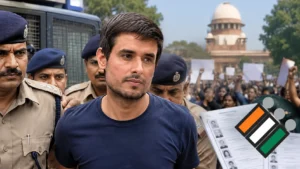
A planned demonstration against Chief Election Commissioner Gyanesh Kumar has triggered mass detentions and extensive security restrictions in the national capital. The dispute centres on allegations linked to voter list revision, raising questions about electoral transparency and the right to peaceful protest.
The Delhi Protests on October 10, 2026, drew attention to the controversy surrounding the Special Intensive Revision (SIR) of electoral rolls after YouTuber Dhruv Rathee and Cockroach Janta Party (CJP) founder Abhijeet Dipke were detained ahead of a planned demonstration against Chief Election Commissioner Gyanesh Kumar.
Reports said police detained Rathee at his Gurugram residence, while Dipke and CJP leaders Saurav Das and Ashutosh Ranka were detained after their aircraft landed at Delhi airport. Authorities had denied permission for the planned gathering at Jantar Mantar and introduced security restrictions across parts of the capital.
The incident raised questions about electoral-roll transparency, the protection of eligible voters and the management of politically sensitive demonstrations. However, allegations of electoral irregularities should not be treated as established facts without supporting evidence.
What Happened During the Delhi Protests on October 10?
The planned demonstration prompted extensive security arrangements across the capital. Reports published on October 10 said police detained several people associated with the protest before they could reach the proposed gathering site.
The major developments included:
- Dhruv Rathee detained in Gurugram: Reports said police detained the YouTuber at his residence in Sector 56 ahead of the demonstration. He had also participated in an anti-SIR protest in Bengaluru on October 8.
- Abhijeet Dipke detained at Delhi airport: Police officers entered the aircraft carrying the CJP founder after it landed in Delhi. CJP leaders Saurav Das and Ashutosh Ranka were also detained.
- Other protesters detained: Reports described preventive action against additional participants, although reported totals varied.
- Security restrictions imposed: Entry and exit gates at 45 Delhi Metro stations were reportedly closed from 9 pm on October 9 until 6 pm on October 10. Interchange facilities remained available at affected stations, except New Delhi station.
- Protest permission denied: Delhi Police had refused permission for the proposed demonstration. Reports cited procedural and security-related concerns.
The detentions prevented the named participants from proceeding to the gathering as planned. However, detention should not be confused with formal arrest, and the legal status of each person requires confirmation through subsequent official updates.
Why Did CJP Demand Gyanesh Kumar’s Resignation?
The main demand behind the demonstration at Jantar Mantar was the resignation of Chief Election Commissioner Gyanesh Kumar. Organisers questioned the Election Commission’s handling of SIR and raised concerns about possible wrongful deletions from electoral rolls.
The Special Intensive Revision is an exercise to verify and update voter lists. It aims to account for changes such as deaths, migration and other circumstances affecting voter registration.
Regular verification helps maintain accurate electoral rolls. However, the process also needs safeguards to ensure eligible citizens are not wrongly excluded.
The current dispute centres on allegations that the revision has led to questionable deletions and insufficient transparency. These concerns require examination through electoral records, deletion reasons, notices and procedures available to affected voters. A missing name alone does not establish deliberate manipulation.
Why Has Form 6 Become Part of the SIR Controversy?
Form 6 is used by eligible citizens to apply for inclusion in the electoral roll, including people registering as new voters. The Election Commission’s Voters’ Services Portal provides access to voter-registration and electoral-roll services.
People who cannot find their names should check the applicable procedure and determine whether Form 6 or another process is appropriate for their circumstances.
The central public-interest question is whether eligible voters can identify errors, submit applications and obtain corrections through a transparent process.
Why Was Dhruv Rathee Detained Before Reaching Jantar Mantar?
Reports published on October 10 said Dhruv Rathee was detained at his Gurugram residence before travelling to Delhi for the demonstration. His participation in the earlier Bengaluru protest had also connected him to the wider campaign over electoral-roll revision.
The incident attracted attention because Rathee regularly comments on Indian politics and public policy. Meanwhile, Dipke and the two CJP leaders were detained separately after their aircraft landed at Delhi airport.
The reported action was described as preventive measures ahead of a gathering for which permission had been denied. However, the precise legal grounds and subsequent status of the individuals should not be assumed without official confirmation.
A detention does not, by itself, establish that someone committed an offence. The legal basis for the action and any subsequent proceedings are separate questions.
How Did the Security Restrictions Affect Delhi Residents?
The reported restrictions extended beyond the protest site, affecting public transport, connectivity and movement through parts of central Delhi.
| Measure | Reported details |
| Delhi Metro | Entry and exit restrictions at 45 stations |
| Mobile internet | Restrictions within a four-kilometre radius of the Janpath–Kartavya Path crossing |
| Road movement | Security checks, barricades and possible traffic diversions |
| Railway travel | Reports indicated changes affecting some train services |
The reported internet suspension ran from 10 pm on October 9 until 10 pm on October 10. The restriction applied to a specified area, not the entire city.
The measures affected people who were not participating in the demonstration, including commuters and residents travelling through central Delhi. Travellers needed to check official transport updates and individual train status before starting their journeys.
Why Do the Delhi Protests Matter?
The Delhi Protests brought two public-interest concerns into focus: electoral-roll transparency and the management of political demonstrations.
For voters, inaccurate electoral rolls can create registration problems that require timely correction. For residents, security restrictions can disrupt travel and access to mobile internet. Authorities also need to communicate the grounds for restrictions and clarify the status of detained participants.
These issues require separate assessments. Allegations about voter deletions need evidence from electoral records, while questions about police action require information about the legal grounds and circumstances of each detention.
What Should Voters Do If Their Names Are Missing?
Eligible voters can take practical steps to check their registration and address possible errors.
- Search for their names through the official ECI voter services portal.
- Check whether Form 6 or another applicable procedure is required.
- Keep application references and acknowledgements where available.
- Follow official instructions about documents, verification and deadlines.
- Contact the relevant electoral registration officer if a problem remains unresolved.
These steps do not settle the wider political allegations, but they can help individuals address registration issues through the prescribed process.
Know More:
Why was the CJP protest planned?
The October 10 demonstration demanded Gyanesh Kumar’s resignation and challenged alleged irregularities in the Special Intensive Revision of electoral rolls.
Was Dhruv Rathee detained?
Reports on October 10 said Rathee was detained at his Gurugram residence ahead of the planned protest. His subsequent legal status should be confirmed through official updates.
Who is Abhijeet Dipke?
Dipke is the founder of the Cockroach Janta Party, a youth-led protest movement. Reports said he was detained with CJP leaders Saurav Das and Ashutosh Ranka after their flight landed in Delhi.
What does SIR mean?
SIR stands for Special Intensive Revision, an exercise to verify and update electoral rolls. The current dispute concerns allegations about voter deletions and transparency.
What Happens Next?
The next developments depend on the status of those detained, any further police action and the organisers’ response. The Election Commission’s explanations of revision procedures and correction mechanisms will also remain relevant to the wider debate.
The Delhi Protests have brought electoral transparency and restrictions on political demonstrations into public discussion. However, the underlying allegations require evidence-based examination rather than assumptions.
You can also read: What the UP Form 9 Dispute Means for Voter List Transparency

