
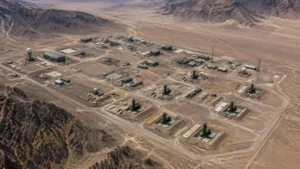
New satellite imagery has revealed an extensive network of China missile field infrastructure emerging around the country’s strategic missile sites in northwestern China, drawing attention from defence analysts and security experts worldwide.
The imagery reportedly shows more than 80 concrete facilities, support structures, communication nodes, and command-related installations near missile silo complexes, particularly around the Hami missile field in Xinjiang. Analysts say the expansion of China missile field infrastructure reflects Beijing’s continuing efforts to modernize its strategic military capabilities.
Experts studying the images believe the construction forms part of a broader long-term project aimed at improving the survivability, flexibility, and operational readiness of China’s strategic forces.
More than 80 facilities identified near missile fields
According to analysts reviewing the satellite imagery, more than 80 facilities have been identified around China’s missile silo complexes. The sites are spread across remote desert regions and appear to be linked by roads, communications infrastructure, and logistical support networks.
Several of the facilities are located near missile fields that have been under development in recent years. Defence observers say the scale of construction suggests a significant infrastructure project rather than routine military activity.
The findings have intensified discussions about the pace of China’s military modernization, with China missile field infrastructure becoming an increasingly important focus for international security analysts.
What could these facilities be used for?
Analysts believe the facilities could support mobile missile launchers, air defence systems, command vehicles, and other military assets. Unlike fixed missile silos, mobile systems can be relocated, making them more difficult to target during a conflict.
Satellite imagery reportedly also shows hardened structures, communication hubs, support buildings, and transportation links that could enable military units to operate across a wider area.
While the exact purpose of the facilities has not been officially confirmed, experts say the expanding China missile field infrastructure appears designed to support a more resilient and dispersed strategic force.
Why is China expanding its nuclear infrastructure?
Security experts believe one possible objective of the project is to strengthen China’s second-strike capability — the ability to respond with nuclear weapons after absorbing an initial attack.
According to reports, a dispersed network of facilities and support infrastructure can make it more difficult for an adversary to disable nuclear forces through a pre-emptive strike. Such systems are generally viewed as enhancing deterrence by helping ensure retaliatory capabilities remain available.
Analysts also point to growing geopolitical competition and evolving security challenges as factors influencing China’s continued military investments. Many experts view the expansion of China missile field infrastructure as part of a broader strategic modernization effort.
Strategic significance of the construction
The newly identified infrastructure reportedly includes command-and-control facilities, communication systems, and support installations that analysts say could play an important role in coordinating missile operations.
Experts note that the project appears to reflect a broader effort to integrate missile silos, mobile systems, and supporting infrastructure into a more comprehensive strategic network. Such an approach could improve operational flexibility while reducing vulnerabilities.
Some analysts have described the development as one of the most significant recent expansions of China missile field infrastructure, given its scale and proximity to strategic missile bases.
Global attention on China’s military modernization
China has repeatedly stated that it adheres to a “no first use” nuclear policy, under which it would not be the first to use nuclear weapons in a conflict. However, the rapid expansion of strategic infrastructure has increased international scrutiny of Beijing’s long-term defence planning.
The emergence of extensive military facilities near missile fields comes as major powers continue to monitor developments in China’s defence sector. Analysts say China missile field infrastructure could influence future discussions on arms control, strategic stability, and military deterrence in the Asia-Pacific region.
With satellite monitoring continuing to reveal new details, observers are expected to closely track the progress of the construction and assess its implications for regional and global security.
Keep visiting WizBloggers for more such informational news.

