
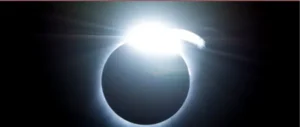
Yesterday’s deep partial lunar eclipse on August 28 brought the full Moon unusually close to totality, while observers in India missed the main celestial event.
A full Moon can remain bright night after night, but its appearance changes dramatically when Earth moves into the right position between the Sun and the Moon. That alignment produced the lunar eclipse on August 28, 2026, as the Moon travelled deep into Earth’s shadow.
The Lunar eclipse August 2026 was not a total lunar eclipse, but it came close. NASA calculated that 96.3% of the Moon’s disc entered the umbra, the darkest part of Earth’s shadow, at the point of greatest eclipse. The remaining portion outside the umbra kept the event in the partial eclipse category.
The eclipse also offered a chance to understand a broader astronomical pattern. Lunar eclipses occur only during full Moons, yet most full Moons do not produce them. NASA’s long term records show how often these eclipses occur, how their types differ and why their visibility changes from one part of Earth to another.
What happened during the lunar eclipse August 2026?
A lunar eclipse occurs when Earth moves between the Sun and the Moon and blocks direct sunlight from reaching the lunar surface.
Earth casts two main shadows. The outer, lighter region is called the penumbra, while the darker central region is known as the umbra.
During the Lunar eclipse August 2026 event, the Moon moved through both regions. The partial phase began at about 2:34 UTC, while greatest eclipse occurred at approximately 4:13 UTC. NASA calculated that 96.3% of the Moon’s disc was within the umbra at that point.
The partial phase lasted about 3 hours and 18 minutes, while the complete event, including the penumbral stages, lasted roughly 5 hours and 38 minutes.
Why was it a partial and not total lunar eclipse?
The classification depends on how much of the Moon enters Earth’s umbra.
A partial lunar eclipse occurs when only part of the Moon passes through the umbra. A total lunar eclipse occurs when the entire lunar disc enters the umbra.
The August 2026 eclipse came close to the second category but did not cross that boundary. NASA’s data show that 96.3% of the lunar disc entered the umbra, leaving a small portion outside the darkest shadow.
NASA also distinguishes between obscuration and eclipse magnitude. The 96.3% figure refers to the area of the Moon’s disc inside the umbra, making it a useful measure of how much of the Moon was actually covered.
Why did the Moon appear reddish on Lunar eclipse August 2026?
The eclipsed Moon can take on a coppery or reddish appearance because of Earth’s atmosphere.
Some sunlight passes through the atmosphere and bends towards the Moon. Atmospheric scattering removes more of the shorter blue wavelengths, allowing more red and orange light to reach the lunar surface.
NASA noted that the coppery colour became perceptible as the Moon moved deeper into the umbra and the surrounding bright portion became smaller.
The popular term “Blood Moon” is generally associated with a reddish total lunar eclipse. Since the August 2026 event was partial, it is more accurate to describe it as a deep partial lunar eclipse with a reddish or coppery appearance in the eclipsed region.
Was the lunar eclipse visible in India?
No, the August 28 lunar eclipse was not visible from India.
The eclipse stages occurred when the Moon was below the horizon for locations such as New Delhi. Astronomical calculations for New Delhi put the maximum eclipse at around 9:43 a.m. IST, but the Moon was not above the horizon at that time
The Lunar eclipse August 2026 was visible across much of the Americas, western Europe and western Africa, with visibility varying according to the stage of the eclipse and local conditions. NASA’s visibility map identifies these regions for the deepest phase.
Therefore, although the eclipse date coincided with Raksha Bandhan in India, people across the country could not directly observe the astronomical event in the sky.
Lunar eclipse and Raksha Bandhan 2026
The eclipse occurred on August 28, 2026, the same date on which Raksha Bandhan was observed in India.
This coincidence generated interest because lunar eclipses and their traditional observances have long been discussed in Indian culture. However, the Lunar eclipse August 2026 itself has a scientific explanation based on the alignment of the Sun, Earth and Moon.
The coincidence of Raksha Bandhan and the lunar eclipse drew attention in India, although the eclipse itself was not directly visible from the country. Traditional practices surrounding eclipses vary among communities and should be presented separately from the astronomical explanation.
Why does a lunar eclipse occur only during a full Moon?
A lunar eclipse can occur only during a full Moon because Earth needs to be positioned between the Sun and the Moon.
However, not every full Moon produces an eclipse.
The Moon’s orbit around Earth is tilted relative to Earth’s orbit around the Sun. As a result, most full Moons pass above or below Earth’s shadow.
An eclipse becomes possible when a full Moon occurs close to one of the points where the Moon’s orbit crosses the plane of Earth’s orbit. NASA’s lunar eclipse catalogue confirms that lunar eclipses can occur only during the full Moon phase.
How often do lunar eclipses occur?
Lunar eclipses occur several times during some years, although the type can vary.
NASA’s catalogue for the 21st century, from 2001 to 2100, lists 228 lunar eclipses. Of these, 86 are classified as penumbral, 57 as partial and 85 as total.
NASA also records between two and five lunar eclipses in a calendar year during this century. Most years have two eclipses, while some have three or four.
Year-wise lunar eclipse details
| Year | Lunar eclipse dates | Types |
| 2021 | May 26, November 19 | Total, Partial |
| 2022 | May 16, November 8 | Total, Total |
| 2023 | May 5, October 28 | Penumbral, Partial |
| 2024 | March 25, September 18 | Penumbral, Partial |
| 2025 | March 14, September 7 | Total, Total |
| 2026 | March 3, August 28 | Total, Partial |
| 2027 | February 20, July 18, August 17 | Penumbral, Penumbral, Partial |
| 2028 | January 12, July 6, December 31 | Partial, Partial, Total |
| 2029 | June 26, December 20 | Total, Penumbral |
| 2030 | June 15, December 9 | Partial, Penumbral |
Source: NASA’s Catalog of Lunar Eclipses, 2001–2100.
How common are total lunar eclipses?
Total lunar eclipses account for a substantial share of lunar eclipses, but they do not occur during every eclipse season.
NASA’s 21st-century catalogue lists 85 total lunar eclipses out of 228, representing about 37.3% of all lunar eclipses during the century. Partial eclipses account for 25%, while penumbral eclipses make up 37.7%.
NASA also identifies July 27, 2018 as the longest total lunar eclipse of the 21st century, with the total phase lasting 1 hour, 42 minutes and 57 seconds.
What is the Saros cycle?
Lunar eclipses also follow recurring patterns known as Saros series.
NASA states that eclipses belonging to the same Saros series are separated by approximately 18 years, 11 days and 8 hours. The additional hours mean that successive eclipses in a series are visible from different parts of Earth.
The August 2026 lunar eclipse belongs to Saros 138. NASA identifies its previous member as the August 16, 2008 eclipse and the next member as the September 7, 2044 eclipse.
The bigger picture
The August 28 lunar eclipse demonstrated how a small difference in the alignment of the Sun, Earth and Moon can determine whether an eclipse becomes partial or total.
Although almost the entire Moon entered Earth’s umbra, the event remained partial because the full lunar disc did not cross into the darkest part of Earth’s shadow on Lunar eclipse August 2026.
NASA’s long-term eclipse records also show that these events follow predictable patterns. Their dates, types and visibility can be calculated far into the future, allowing scientists and skywatchers to track lunar eclipses with considerable precision.

