
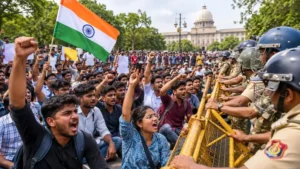
Thousands of aspirants have intensified their agitation over alleged irregularities in recruitment exams, demanding accountability, a probe and action on disputed examinations.
The Jharkhand student protest has intensified over alleged irregularities in recruitment examinations conducted by the Jharkhand Public Service Commission (JPSC) and Jharkhand Staff Selection Commission (JSSC).
Thousands of government job aspirants have been protesting in Ranchi, seeking greater transparency in recruitment examinations and action over tests they believe were affected by irregularities.
The latest escalation came on August 10, when protesting aspirants marched towards the Jharkhand Vidhan Sabha. Police used water cannons and reportedly resorted to lathicharge after protesters breached multiple barricades while advancing towards the Assembly.
The agitation has also gained fresh attention following reports about the Jharkhand CID investigation into the 2024 JSSC Combined Graduate Level (CGL) examination. The CID’s initial report, according to media reports, concluded that 120 of the 150 questions had been leaked before the examination. A subsequent SIT investigation did not substantiate an organised paper leak, leaving conflicting findings in the case.
The latest developments have added to the concerns of aspirants demanding accountability in the state’s recruitment examination system.
Why are Jharkhand students protesting?
The current agitation is centred on alleged irregularities in several JPSC and JSSC recruitment examinations.
A key concern among the protesters is the alleged leakage of examination material before candidates appeared for the tests. Students have also questioned how earlier investigations into examination-related allegations were handled.
The 2024 JSSC CGL examination has emerged as one of the main issues in the latest phase of the agitation.
A reported CID investigation concluded in March 2025 that 120 of the 150 questions in the examination had been leaked before the test. Reports said answers were circulated among candidates through WhatsApp.
However, a subsequent Special Investigation Team (SIT) investigation reportedly did not substantiate the paper leak allegation. The difference between the two investigations has become an important part of the students’ concerns.
Aspirants are now demanding greater transparency over the investigation process and action in cases where examination malpractice is established.
Jharkhand student protest timeline
The present phase of the agitation has continued for several days, with students increasing pressure on the state government over their demands.
July 29: Aspirants begin extended protest
The current agitation began on July 29, when job aspirants started an indefinite sit-in in Ranchi over alleged irregularities in JPSC and JSSC examinations.
The Jaipal Singh Munda Stadium became one of the main gathering points for the protesting aspirants.
The students called for corrective measures, transparency in recruitment examinations and investigations into allegations of malpractice.
Hunger strike intensifies agitation
Student leader Devendra Nath Mahto joined the agitation and went on hunger strike as the protest continued.
Reports said Mahto remained on hunger strike for nine days before joining the larger mobilisation. His participation became a prominent part of the ongoing student movement.
Government says most demands addressed
The ruling JMM and government representatives said that around 98% of the protesters’ demands had been addressed.
The protesters, however, disputed this assessment. They maintained that their principal concerns, particularly those involving examination cancellations and an independent investigation, remained unresolved.
Government agrees to cancel JPSC examinations
The government agreed to cancel the 14th JPSC examination and certain backlog examinations.
However, the protesters continued to demand cancellation of the JSSC CGL examination and a wider independent investigation into allegations surrounding recruitment examinations.
The government maintained that the JSSC CGL examination had been conducted under court supervision and that selected candidates were already working.
Students announce Assembly march
With the disagreement continuing, the protesters announced a march towards the Jharkhand Vidhan Sabha.
Authorities increased security around the Assembly and placed barricades in the area to prevent protesters from entering restricted zones.
August 10: Jharkhand student protest reaches Assembly
On August 10, thousands of aspirants marched towards the Jharkhand Assembly.
As protesters breached multiple barricades while advancing towards the Assembly, police used water cannons and reportedly resorted to lathicharge as tensions escalated.
The confrontation marked a further escalation in the dispute between the protesting aspirants and the state government.
Former JPSC chairman L Khiangte arrested
Another significant development came on August 10, when Jharkhand CID arrested former JPSC chairperson L Khiangte in connection with alleged irregularities in recruitment examinations.
The arrest came as the student agitation entered another critical phase in Ranchi.
The development has added to scrutiny of the functioning of the state’s recruitment examination system and comes amid demands from protesters for stronger action against those responsible for alleged irregularities.
What is the JSSC CGL paper leak controversy?
The JSSC Combined Graduate Level examination has become one of the central issues in the Jharkhand student protest.
The 2024 examination had faced allegations of question paper leakage. A CID investigation reportedly completed in March 2025 concluded that 120 of the 150 questions had been leaked before the examination.
Reports said answers to the questions were circulated through WhatsApp before candidates appeared for the examination.
However, a subsequent SIT investigation reportedly reached a different conclusion and did not substantiate the paper leak allegation.
The conflicting findings have become significant for protesting aspirants, who are seeking clarity over how the allegations were investigated and whether further action is required.
The issue is therefore not limited to the alleged leakage itself. It also concerns the manner in which allegations of examination malpractice were investigated and addressed.
What are the students demanding in the Jharkhand Student protest?
The protesters’ demands centre on fairness, transparency and accountability in government recruitment examinations in this Jharkhand Student protest.
Among the key issues raised during the agitation are:
- Action over alleged irregularities in recruitment examinations.
- Investigation into alleged paper leaks and examination malpractice.
- Greater transparency in the JPSC and JSSC examination process.
- Action against those found responsible for examination irregularities.
- Cancellation or review of examinations that protesters believe were compromised.
- An independent investigation into the allegations, including the demand for a CBI probe.
The disagreement between the government and the protesters largely concerns whether the measures announced so far adequately address these demands.
While the government and ruling JMM have said that most demands have been addressed, the protesting aspirants maintain that their principal concerns remain unresolved. The government also said it would recommend an Enforcement Directorate probe into alleged financial irregularities linked to JPSC examinations.
Where does Abhijeet Dipke stand on the Jharkhand protest?
Abhijeet Dipke, founder of the CJP, has publicly expressed solidarity with the protesting students.
Dipke shared a video of student leader Devendra Nath Mahto participating in the Assembly march and backed the students’ movement.
A CJP delegation had also reached Ranchi ahead of the planned Assembly march in support of the protesters.
Dipke’s public statements have therefore placed the CJP among the groups expressing support for the students’ demands. The focus of the organisation’s stated support has been on accountability and transparency in the recruitment examination process.
Why has the Jharkhand Student protest become important?
The agitation is no longer limited to one examination.
For thousands of government job aspirants, recruitment examinations are an important route to public-sector employment. Allegations of question paper leaks or other irregularities can therefore have a direct impact on candidates preparing for competitive examinations.
The latest attention on the JSSC CGL case has added another dimension to the controversy because the reported CID findings relate to questions allegedly being available before the examination.
The conflicting investigation findings have also raised questions about how examination agencies and investigating authorities should respond when allegations emerge after an examination has been conducted and the recruitment process has progressed.
What happens next in the Jharkhand exam row?
The immediate focus remains on the government’s response to the protesters’ demands, the ongoing investigations and the status of the examinations under scrutiny.
The August 10 Assembly march escalated the confrontation after protesters breached security barricades and police used water cannons and reportedly lathicharge.
The arrest of former JPSC chairman L Khiangte on the same day has also added a significant development to the examination controversy.
At the same time, the reported CID findings concerning the 2024 JSSC CGL examination have brought renewed attention to the alleged paper leak and the subsequent investigation.
The protesters continue to seek stronger action, greater transparency and an independent investigation into the allegations.
For now, the JPSC-JSSC examination row remains unresolved, with the students’ demands and the government’s position still at odds.
You may like to read: FCRA Bill explained: Why India’s foreign funding law is at the centre of global attention

