
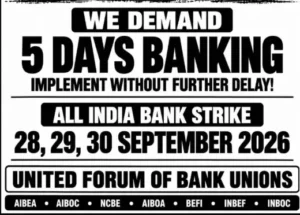
Public sector banks and regional rural banks will keep branches open on Sunday, September 27, ahead of the three-day strike. SBI has also waived ATM transaction charges during the strike period.
Public sector banks (PSBs) and regional rural banks (RRBs) are scheduled to operate on Sunday, September 27, 2026, ahead of a proposed nationwide bank strike from September 28 to 30. The additional working day is intended to reduce disruption and give customers more time to complete banking tasks that require branch assistance.
The bank strike september 2026 has been called by the United Forum of Bank Unions (UFBU), with the demand for a five-day banking week remaining the main unresolved issue. The unions have maintained that the arrangement was agreed with the Indian Banks’ Association during the March 2024 wage settlement process.
The Finance Ministry, however, has said there was no government commitment to implement a five-day banking week. The proposal was sent to the government and remains under consideration.
The government has also said that the Performance Linked Incentive (PLI) issue has already been kept in abeyance and urged employees to continue discussions on the remaining matters.
When is the bank strike?
The proposed nationwide bank strike september 2026 is scheduled for Monday, September 28, to Wednesday, September 30, 2026.
The timing is important because September 30 is also the half-yearly closing date for banks. The government has pointed to the importance of this date for activities such as reconciliation, provisioning and treasury and market operations.
Bank strike 2026 key dates
| Date | What it means |
| September 26 | Saturday |
| September 27 | PSBs and RRBs scheduled to operate normally |
| September 28 | First day of proposed strike |
| September 29 | Second day of proposed strike |
| September 30 | Third strike day and half-yearly closing |
Why are banks opening on Sunday?
The September 27 opening is aimed at reducing the inconvenience that could arise from the strike beginning immediately after the weekend.
The government has announced that PSBs and RRBs will operate normally on Sunday, while the Reserve Bank of India has approved the operation of bank branches, offices, ATM-linked branches and currency chests on that day.
For customers, this provides an additional opportunity to complete work that cannot easily be done online. People with pending documentation, account-related work, cash requirements or other branch-dependent tasks can use the additional working day where the required service is available.
Customers should still check their bank’s latest branch-level advisory before visiting.
Which banking services could be affected?
The bank strike september 2026 is expected to have its most direct impact on branch-based and employee-assisted services. Transactions requiring staff intervention may face delays during the strike period.
However, the strike does not necessarily mean that digital and self-service banking channels will stop functioning.
Customers are expected to have alternatives such as:
- ATMs and cash machines
- UPI payments
- Mobile banking
- Internet banking
- Other self-service channels
- Business correspondents and customer service points, where available
The availability of individual services can depend on the bank’s systems and the nature of the transaction.
What has SBI said about ATM charges?
State Bank of India has announced a waiver of ATM transaction charges for its customers during September 28-30.
The move gives SBI customers another option for accessing cash while branch operations may be affected. However, customers who know they will need cash around the strike should avoid waiting until the last moment.
Will UPI and internet banking work?
Customers are expected to be able to use UPI, mobile banking and internet banking for routine transactions, subject to the availability of individual bank systems during the bank strike september 28-30.
This means people who only need to transfer money, make digital payments, check account information or complete other digitally supported transactions may be able to avoid a branch visit.
However, customers requiring physical documents, verification or staff assistance should complete those tasks before September 28 where possible.
Who will be affected?
The impact will vary depending on the type of banking service a person needs.
Bank customers: People requiring branch services should complete important work before the strike or use the September 27 Sunday banking facility where applicable.
Businesses: Companies handling payments, reconciliations and other banking-related work around the September 30 half-yearly closing may need to plan transactions in advance.
Central Government employees and pensioners: The government has allowed early disbursement of September salaries and pensions for eligible Central Government employees and pensioners covered by its instructions.
Bank employees: The strike is linked mainly to the demand for a five-day banking week, along with other employee and service-related issues.
Digital banking users: Customers who can complete transactions through UPI, internet banking, mobile banking or ATMs have additional alternatives during the strike.
What about salaries and pensions?
According to government instructions, September 2026 salaries and wages of eligible Central Government employees may be drawn and disbursed on September 25 because of the proposed strike. The arrangement covers Central Government offices, including Defence, Posts and Telecommunications.
September pensions for eligible Central Government pensioners may also be disbursed on September 25.
This is a specific government arrangement and should not be treated as an early-salary measure for all private-sector employees.
Why is the five-day banking week being demanded?
The proposed five-day banking arrangement would make Monday to Friday the regular working days, with Saturdays becoming holidays.
Under the existing arrangement, the second and fourth Saturdays are holidays for banks, while other Saturdays are generally working days.
According to the union position, the proposed change would be accompanied by an increase of around 40 minutes in daily working hours from Monday to Friday.
The key issue now is whether the government will approve the proposal for implementation. The unions maintain that the five-day arrangement was agreed with the Indian Banks’ Association in 2024 and subsequently sent to the government. The Finance Ministry has said it did not make a commitment to implement the proposal.
Why the bank strike matters
For most customers, the immediate concern related to bank strike September 2026 is access to branch banking.
The September 28-30 strike overlaps with the period leading up to the September 30 half-yearly closing. Businesses and other organisations with time-sensitive banking work may therefore need to plan transactions ahead of the strike.
The Sunday opening provides an additional opportunity for customers to complete branch-dependent work. Digital channels can handle many routine transactions, but they cannot replace every service offered at a physical branch.
What should customers do before September 28?
Customers can take a few simple steps:
- Complete important branch-related work before September 28.
- Use September 27 Sunday banking where the required service is available.
- Keep necessary cash available in advance.
- Use UPI, internet banking and mobile banking for routine transactions.
- Check the latest advisory from your bank before visiting a branch.
- Avoid postponing time-sensitive banking work until September 30.
Could there be another strike in October?
The government has confirmed the September 28-30 strike schedule. Separately, bank unions have proposed an indefinite nationwide strike from October 26 if the dispute remains unresolved.
The October action is therefore a proposed future step and should not be treated as an ongoing strike.
FAQs
When is the bank strike in September 2026?
The proposed nationwide strike is scheduled for September 28, 29 and 30, 2026.
Are banks open on September 27, 2026?
PSBs and RRBs are scheduled to operate normally on Sunday, September 27. Customers should check whether their branch provides the specific service they need.
Will ATMs work during the bank strike?
ATMs are expected to remain an important alternative during the strike. SBI has announced a waiver of ATM transaction charges for its customers during September 28-30.
Will UPI work during the bank strike?
UPI and other digital banking services are expected to remain available for routine transactions, subject to individual bank systems and service availability.
Why are bank employees going on strike?
The main unresolved demand is implementation of a five-day banking week. Unions have also raised other employee and service-related issues.

