
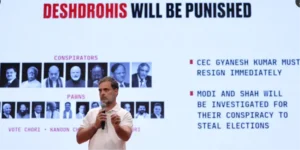
The Gyanesh Kumar SIR row has intensified after two Election Commissioners reportedly recorded 14 objections over 10 months, while Rahul Gandhi, Akhilesh Yadav and Priyanka Gandhi demanded action and the CJP announced a nationwide protest call from October 2.
Chief Election Commissioner Gyanesh Kumar has come under renewed political pressure after reports of internal objections within the three-member Election Commission over decisions linked to electoral-roll management and the Special Intensive Revision (SIR).
Election Commissioners Sukhbir Singh Sandhu and Vivek Joshi reportedly recorded at least 14 objections over a period of 10 months. The issues included voter additions and deletions, changes to Form 6, appeals related to electoral-roll decisions and access to systems handling voter data.
The Election Commission has not disputed the existence of the reported objections. However, it has said that internal observations and differences are part of institutional deliberations and maintained that decisions taken by the Commission, including those related to SIR, were unanimous.
What were the reported objections inside the Election Commission?
The reported objections covered several aspects of electoral-roll administration.
One issue concerned Form 6, which is used by eligible citizens to apply for inclusion in the electoral roll. The reported objection questioned changes made to the form without corresponding changes to the rules.
Other concerns involved the addition, deletion and restoration of names on electoral rolls, appeals against voter-related decisions and access to the Election Commission’s electoral-roll software.
The report also referred to a Goa case involving 97 voters. Electoral officers had reportedly found them eligible after examining their cases, but the voters were left out of the final roll because the software did not allow officials to reverse an earlier decision in the system.
These reported cases have become a major part of the political debate over the SIR process.
What did Rahul Gandhi say about Gyanesh Kumar?
Rahul Gandhi demanded Gyanesh Kumar’s resignation on September 24 while attacking the Election Commission over the SIR controversy.
He connected the reported objections by the two Election Commissioners with his broader allegations of electoral malpractice. Gandhi used the expressions “vote chori” and “kanoon chori” while arguing that alleged irregularities in elections could affect the legitimacy of laws passed by elected lawmakers.
Gandhi also called on Kumar to become an approver, saying it would be in the country’s interest. These are Gandhi’s political allegations and demands; they do not by themselves establish that electoral manipulation took place.
What did Akhilesh Yadav say?
Samajwadi Party president Akhilesh Yadav has also demanded Gyanesh Kumar’s resignation.
Yadav’s comments came amid the controversy over the reported objections raised by Sandhu and Joshi. He said the CEC should resign on his own and questioned whether elections should be conducted under the current leadership of the Election Commission.
His remarks form part of the wider Opposition response to the reported internal differences within the poll panel.
What did Priyanka Gandhi say about the SIR controversy?
Congress MP Priyanka Gandhi Vadra criticised the Election Commission during an interaction with reporters in Wayanad on September 24.
She said that if anyone was found responsible for tampering with electoral rolls or deleting voters’ names, criminal prosecution should follow. She also described interference with the democratic election process as an offence against the nation.
Her statement was framed around a condition — responsibility would have to be established first. It does not establish that Gyanesh Kumar personally tampered with electoral rolls.
What is the CJP deadline for Gyanesh Kumar?
The Cockroach Janta Party has demanded that Gyanesh Kumar resign by Saturday, September 26, 2026.
CJP founder Abhijeet Dipke said the group would start a nationwide protest from Mumbai on October 2 if Kumar does not resign by the deadline. The proposed October 2 action is therefore the protest date, not the resignation deadline.
The CJP’s protest plan is separate from the Congress programme announced over the SIR controversy.
CJP timeline
| Date | Development |
| September 25, 2026 | CJP reiterates its demand for Kumar’s resignation |
| September 26, 2026 | Deadline set by CJP for Kumar to resign |
| October 2, 2026 | CJP says nationwide protests will begin if he does not resign |
What protests has Congress announced?
Congress has announced a two-stage protest programme.
The party directed its state units to organise marches to their respective State Election Commission offices on September 25. It also asked District Congress Committees to hold protests at district collectorates on September 28.
Congress has demanded Kumar’s removal and an independent review of decisions and electoral-roll changes made during his tenure. These demands reflect the party’s political position on the issue.
What is the Opposition seeking against Gyanesh Kumar?
Apart from resignation demands and street protests, Opposition parties have also discussed parliamentary action against the CEC.
Reports on September 24 said Opposition parties were preparing a motion seeking Kumar’s removal from office. The move followed the reports about the 14 objections recorded by Sandhu and Joshi.
This is separate from the CJP’s protest deadline and the Congress-led street demonstrations.
What is SIR and why is it part of the controversy?
SIR stands for Special Intensive Revision of electoral rolls. It is an Election Commission exercise for reviewing and updating voter lists.
The present controversy concerns reported disagreements over how some electoral-roll decisions and related systems were handled during the SIR process.
The reported objections involved several areas, including Form 6, voter additions and deletions, appeals and access to electoral-roll software. The Goa case involving 97 eligible voters has also become part of the discussion around the functioning of the software used in the process.
At the same time, the Election Commission has rejected the interpretation that the internal objections show that its final decision-making process was divided. It has maintained that the Commission’s decisions were unanimous.
Gyanesh Kumar SIR row explained in 5 points
| Issue | What has been reported | Position or response |
| Internal objections | Sandhu and Joshi recorded at least 14 objections over 10 months | ECI says internal differences are part of normal deliberations |
| Form 6 | Questions were raised over changes to the voter-registration form | The reported objection questioned the basis for the changes |
| Electoral-roll systems | Concerns were raised over access and software-related decisions | ECI maintains that its decisions were taken unanimously |
| Goa voters | 97 eligible voters were reportedly left out after a software-related problem | The case has added to questions around the SIR process |
| Political response | Opposition leaders have demanded action against Kumar | These are political demands, not findings establishing wrongdoing |
What happens next in the Gyanesh Kumar SIR row?
The next immediate date is September 26, when the CJP’s resignation deadline expires.
Congress has also scheduled its second phase of protests for September 28, while the Opposition has discussed parliamentary action against Kumar.
Meanwhile, the Election Commission’s position remains that the reported internal objections were part of deliberation and that its final decisions were unanimous.
The dispute now centres on the reported internal objections, the implementation of SIR and the competing political claims about the Election Commission’s functioning.

