
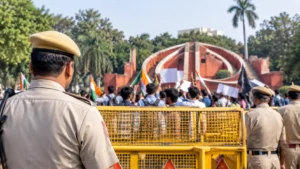
Delhi’s decision to remove Jantar Mantar Road from its designated protest sites has intensified a political dispute over voter-list revisions, police detentions and the right to demonstrate.
Delhi Police has removed Jantar Mantar Road from its list of designated protest venues, naming Ramlila Ground, Burari Ground and CBD Ground in East Delhi as alternatives. The decision has intensified a political confrontation as the Cockroach Janta Party (CJP) demands Chief Election Commissioner Gyanesh Kumar’s resignation over alleged irregularities in voter-list revisions.
The change came through a standing order issued by Delhi Police Commissioner Anurag Kumar on October 11, 2026. It followed a Supreme Court direction to identify suitable alternative locations for demonstrations. CJP founder Abhijeet Dipke and other party members have criticised the decision regarding Jantar Mantar Protests, arguing that they will continue despite restrictions at the historic venue.
The controversy now involves three connected issues: the administration of electoral rolls, the police’s regulation of demonstrations and the ability of political groups to assemble at designated public locations.
What Are the Jantar Mantar Protests About?
The Jantar Mantar protests centre on demands for Gyanesh Kumar to resign as Chief Election Commissioner following allegations of irregularities in the Special Intensive Revision (SIR) of electoral rolls.
SIR is a voter-list verification and revision exercise intended to update electoral records. The dispute concerns whether the process has removed eligible voters’ names and whether the Election Commission of India (ECI) has provided adequate transparency and safeguards against errors.
CJP and opposition groups have questioned the handling of voter-list revisions, alleging that the process could disenfranchise eligible voters. They have called for accountability from the Election Commission and greater clarity on how disputed entries are examined.
The Election Commission has rejected allegations of political bias and maintained that electoral rolls require updating. Its position is that records may include deceased voters, people who have moved or individuals who cannot be traced. It has also said that people whose names have been wrongly removed can apply for enrolment again.
These competing positions remain central to the dispute. Allegations of deliberate voter exclusion cannot be treated as established findings without evidence showing how the revision was conducted and whether eligible voters were wrongly removed.
Why Has Delhi Removed Jantar Mantar as a Designated Protest Site?
Jantar Mantar has long been associated with demonstrations by political parties, student organisations and civil society groups. Its location in central Delhi has made it a prominent place for protesters seeking public attention for their demands.
Delhi Police removed its designated protest-site status through an order dated October 11. The decision followed a Supreme Court direction concerning the identification of suitable alternative locations for protests.
The three alternative venues named by Delhi Police are:
- Ramlila Ground: Located in central Delhi.
- Burari Ground: Located in north Delhi.
- CBD Ground: Located in east Delhi.
Delhi Police explained the change in proceedings before the Delhi High Court, referring to the Supreme Court’s direction and the process of identifying alternative locations.
The distinction is important: removing Jantar Mantar from the designated-site list does not mean that all demonstrations across Delhi have been prohibited. However, organisers can no longer rely on its earlier status as an approved protest venue and must follow applicable permissions and police directions.
The practical arrangements at the new sites also matter. Organisers need clear information about permission procedures and the conditions under which demonstrations can take place. The decision has therefore raised questions about access, visibility and the convenience of alternative locations for protesters participating in the Jantar Mantar protests.
Why Were Abhijeet Dipke and Other CJP Leaders Detained?
On October 10, Delhi Police detained CJP founder Abhijeet Dipke and party leaders Saurav Das and Ashutosh Ranka after they arrived at Indira Gandhi International Airport ahead of a planned demonstration.
The detentions took place as authorities sought to prevent the gathering from proceeding without the required permission. Videos circulated by the movement showed police personnel entering the aircraft after it landed, while Dipke questioned the manner in which officers approached him.
The CJP criticised the action and described it as an attempt to prevent its leaders from joining the protest. The police action came amid heightened security and restrictions surrounding the planned demonstration.
The situation developed further on October 13, when CJP members entered the Jantar Mantar area despite the change in its designated status. Police detained members of the group after they crossed barricades, according to reports.
Das and Ranka were subsequently produced before a Special Executive Magistrate and remanded to five days of judicial custody in Tihar Jail. Their legal status is therefore different from that of people who were released after earlier preventive detentions. The later court action should not be confused with the airport incident on October 10.
Dipke criticised the police action and reiterated that the movement would continue. He also warned that demonstrations could spread to other parts of the country if protesters were prevented from assembling at Jantar Mantar.
What Is the Opposition Saying About the Restrictions?
Opposition leaders have criticised the restrictions and detentions, arguing that peaceful demonstrations are an important means of questioning public authorities.
Their objections concern both the handling of the protests and the underlying allegations about voter-list revisions. They have called for greater accountability from the Election Commission and questioned whether police action is making it harder for demonstrators to raise concerns.
The authorities’ position must also be considered. The venue change followed a Supreme Court direction to identify alternative protest locations, while the police have cited permission requirements in connection with the planned demonstrations.
These are separate questions. The legal basis for designating protest sites does not, by itself, settle whether every individual police action was justified. Similarly, opposition criticism does not establish that the venue change was intended to suppress a particular political movement.
A fair assessment requires the relevant court orders, police directions and records of individual detentions to be considered separately.
Why Do the Jantar Mantar Protests Matter?
The Jantar Mantar protests matter because designated protest venues affect how citizens and organisations exercise their right to assemble peacefully.
Jantar Mantar’s central location has historically helped protesters attract public attention. Moving demonstrations to other sites may change how easily participants can reach them and how visible their demands are, although the actual effect will depend on access arrangements and permissions.
The change also has implications for public administration. Authorities must manage security, traffic and public order while ensuring that applicable legal protections for peaceful assembly are respected.
For voters, the larger issue remains the accuracy and transparency of electoral rolls. People concerned that their names have been wrongly removed need clear information about how to check their status and apply for corrections or enrolment. Political allegations alone cannot establish the scale of any errors; that requires verifiable records and evidence.
What Happens Next in the Jantar Mantar Protest Row?
The immediate questions concern the implementation of arrangements at the three alternative protest sites, the legal proceedings connected with recent detentions and whether CJP can organise further demonstrations under the applicable rules.
The Delhi High Court has also heard challenges connected with the denial of permission to protest at Jantar Mantar. Further proceedings may clarify the legal and administrative issues surrounding the change, but the outcome should not be assumed before the court makes a decision.
Separately, the dispute over voter-list revisions will require evidence about the verification process, disputed entries and the remedies available to affected voters.
For now, the removal of Jantar Mantar from the designated protest-site list has changed the arrangements for demonstrations in Delhi, but it has not resolved the wider disagreement over electoral transparency. The next developments will depend on official decisions, court proceedings and evidence relating to the voter-list revision process.

