

A new MDR framework will apply to specified merchant UPI payments above Rs 2,000 from October 15, while person-to-person transfers and most merchant transactions will remain free.
India’s UPI ecosystem is moving to a new merchant pricing framework from October 15, 2026. Under the revised arrangement, a 0.4% MDR will apply to specified P2M UPI transactions above ₹2,000, with a maximum MDR of ₹300 for transactions of ₹75,000 or more. The government has clarified that this is not a direct transaction fee on consumers.
P2P UPI payments will continue to remain free, while merchant payments up to ₹2,000 and eligible small-merchant transactions will continue under zero-MDR provisions. The government estimates that about 96% of P2M transactions will remain unaffected.
What are the new UPI merchant charges from October 15?
The standard MDR will be 0.4% for specified P2M transactions above ₹2,000. For transactions of ₹75,000 or more, the MDR is capped at ₹300. The charge is borne within the payment ecosystem rather than being imposed directly on the customer.
The government has also specified separate treatment for some categories. Transactions in sectors such as railways, telecommunications, insurance, fuel and agricultural inputs will attract a flat ₹5 MDR under the specified category. Certain capital-market transactions, including those involving mutual funds and securities, will have an MDR of 0.02%, capped at ₹300.
Therefore, the new framework should not be described as a blanket 0.4% UPI charge on every payment above ₹2,000.
Standard 0.4% MDR examples
| UPI payment | Standard MDR |
| ₹5,000 | ₹20 |
| ₹20,000 | ₹80 |
| ₹50,000 | ₹200 |
| ₹75,000 | ₹300 |
| Above ₹75,000 | ₹300 maximum |
These examples apply only where the transaction falls under the standard 0.4% MDR category.
Will customers have to pay for UPI transactions?
No direct UPI transaction fee is being introduced for consumers under this framework.
P2P UPI transfers will remain free regardless of the amount. Merchant payments up to ₹2,000 will also remain free of MDR. The government has also said banks have been advised to ensure the merchant-side MDR is not passed on to customers.
This makes the distinction between UPI merchant charges and customer UPI charges important. MDR is a merchant-side payment-processing charge and is not the same as adding a fee to the customer’s UPI transaction.
How UPI grew into India’s everyday payment system
UPI was launched by NPCI in April 2016, initially with 21 banks participating. Since then, the system has expanded rapidly across retail, online and person-to-person payments.
Government data based on NPCI figures shows annual UPI transaction volume rising from 1.78 crore in FY 2016-17 to 24,161.69 crore in FY 2025-26. The annual transaction value increased from ₹0.07 lakh crore to about ₹314.23 lakh crore during the same period.
| UPI milestone | Figure |
| Annual transactions in FY 2016-17 | 1.78 crore |
| Annual transactions in FY 2025-26 | 24,161.69 crore |
| Annual transaction value in FY 2016-17 | ₹0.07 lakh crore |
| Annual transaction value in FY 2025-26 | ₹314.23 lakh crore |
| July 2026 transaction volume | 2,366 crore |
| July 2026 transaction value | ₹29.88 lakh crore |
The latest NPCI data shows that UPI processed 24,508.96 million transactions worth ₹29,82,355.95 crore in August 2026, with 752 banks live on the network.
August’s volume was therefore higher than July’s 2,366 crore transactions, making the July figure an earlier monthly record rather than the latest one.
How do digital payment costs compare across countries?
The World Bank Domestic Payments Costs Dataset provides international data on the cost of domestic payment channels. Its broader P2B comparison shows that payment costs vary between countries and between in-person and remote transactions.
Average P2B payment cost by country
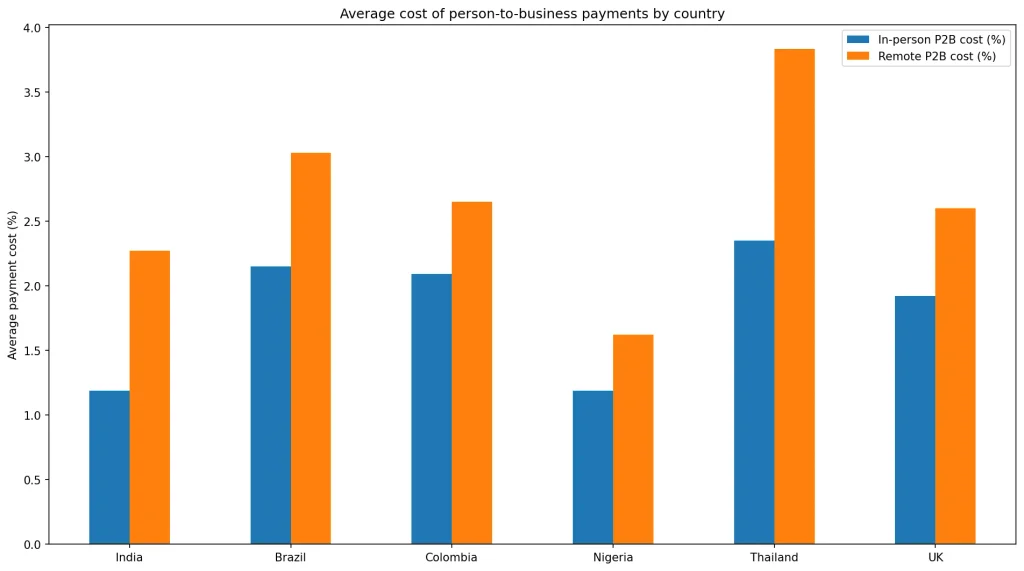
These figures represent broader payment-channel costs and should not be treated as current UPI MDR rates.
The World Bank also separately compared fast-payment systems. In that comparison, the average P2B payment cost recorded for UPI was 0%, compared with 1.18% for Brazil’s Pix and 1.21% for Thailand’s PromptPay.
The 0% UPI figure belongs to this specific fast-payment comparison and should not be confused with India’s broader 1.19% in-person and 2.27% remote P2B figures.
How does UPI compare with Pix and other payment systems?
India’s UPI is often compared with Brazil’s Pix because both are instant payment systems that have become widely used for everyday digital transactions.
Pix is Brazil’s instant payment system, launched by the Central Bank of Brazil in 2020. It allows individuals and businesses to make real-time payments and transfers, including through QR codes. Its rapid adoption has made it a useful international comparison when looking at the cost and reach of instant digital payments.
The World Bank’s payment-cost comparison recorded an average P2B cost of 0% for UPI, compared with 1.18% for Pix and 1.21% for Thailand’s PromptPay in the specific fast-payment comparison. These figures should be read separately from the broader P2B payment-cost table, which covers different payment channels and transaction types.
Why has the government introduced UPI MDR?
The government’s stated rationale is centred on the long-term sustainability of the UPI ecosystem.
According to the government, the revised framework creates a revenue mechanism for participants in the payment ecosystem while continuing to protect individual users and small merchants. The policy also aims to support investment in infrastructure, innovation, cybersecurity and the wider expansion of digital payments.
A separate fund for small-merchant UPI adoption will also receive an amount equivalent to 5% of total MDR collections, according to the government.
What could UPI merchant charges mean for businesses?
The impact will depend on the merchant’s transaction value and category.
For an applicable ₹5,000 transaction, 0.4% MDR would be ₹20. For ₹20,000, it would be ₹80, while ₹75,000 reaches the ₹300 cap.
Businesses receiving a large number of applicable higher-value UPI payments may therefore face an additional payment-processing cost. However, the effect will vary depending on their margins, transaction mix and applicable MDR category.
Could UPI merchant charges affect customers indirectly?
There is no announced direct customer fee under the new framework. The government has said the MDR should not be passed on to customers.
However, individual businesses may decide how to manage their payment costs. They could absorb the expense or make other commercial adjustments. The actual effect on prices and payment behaviour will become clearer after the framework takes effect.
What are Opposition MPs saying about the new UPI fee?
Media reports on September 16 said some members of the Parliamentary Standing Committee on Finance raised concerns about the new MDR during a committee meeting.
The concerns relate to the possible impact of the new merchant-side charge on India’s widely used digital payment system. The government’s position remains that the MDR applies only to specified merchant transactions and that most P2M payments will remain unaffected.
What is the difference between UPI MDR and a UPI customer charge?
UPI MDR is a merchant-side payment-processing charge. The new standard rate is 0.4% for specified P2M transactions above ₹2,000, subject to category-specific rules and the ₹300 cap.
It is not a fee added to the customer’s UPI payment. P2P payments remain free.
Is UPI still free for person-to-person payments?
Yes. P2P UPI transfers will remain free regardless of the amount transferred.
Will every UPI payment above ₹2,000 attract 0.4% MDR?
No. The 0.4% rate applies to specified P2M transactions. Some sectors have separate MDR rates, while eligible small merchants continue under zero-MDR provisions. The government estimates that around 96% of P2M transactions will remain unaffected.
What does the new UPI model mean
The October 15 framework marks a change in the economics of specified merchant UPI payments. It introduces MDR for selected higher-value transactions while retaining free P2P payments and zero-MDR treatment for eligible lower-value and small-merchant transactions.
UPI’s latest transaction numbers show the scale of the network. How merchants and payment providers respond to the new framework will determine its practical impact after implementation.
Also read: BRICS Summit 2026 brings Modi, Putin and Xi together as bloc condemns Pahalgam terror attack

