
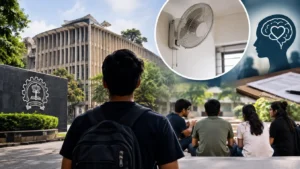
IIT Bombay has started replacing ceiling fans with wall-mounted units as students push for wider changes in mental-health care, grievance handling and student welfare after BTech student Sahil Wakode’s death.
IIT Bombay is facing renewed questions about student welfare following the death of Sahil Wakode, a second-year BTech student from the Department of Energy Science and Engineering.
The developments on IIT Bombay reforms involve two separate areas. One is a change in hostel infrastructure, with ceiling fans being replaced by wall-mounted fans. The other involves a wider set of student demands related to mental-health services, welfare, grievance redressal, healthcare and institutional procedures.
The fan replacement has drawn attention because it comes amid protests following Wakode’s death. However, IIT Bombay has said that the replacement work is part of a planned hostel renovation programme.
At the same time, students have submitted an 18-point charter of demands to the institute. IIT Bombay Director Shireesh Kedare met the protesting students and signed the charter following discussions. The implementation of the demands remains an important part of what happens next.
The circumstances surrounding Wakode’s death are also being examined by Mumbai Police.
Why is IIT Bombay replacing ceiling fans?
IIT Bombay has begun replacing ceiling fans with wall-mounted fans in hostel rooms, with the first batch of the new fans reaching the campus.
The timing has led to considerable attention because the change comes after recent student deaths at the institute. However, IIT Bombay has said the fan replacement is part of planned hostel renovation work.
This distinction is important. The institute has not described the fan replacement as a measure introduced specifically because of Wakode’s death.
The infrastructure change is taking place alongside a much broader discussion about student welfare. Students are seeking changes in areas such as counselling, psychiatric support, grievance handling, healthcare and disciplinary procedures.
Therefore, the wall-mounted fans should be viewed as one infrastructure development taking place at the institute, rather than as the main reform resulting from the protests.
What are IIT Bombay students demanding?
Students have submitted an 18-point charter of demands following Wakode’s death and the protests on campus.
The charter covers several aspects of student life and institutional functioning. Director Shireesh Kedare signed the document after meeting students and discussing their concerns.
Among the reported areas covered by the demands are:
- stronger mental-health and counselling services;
- improved student welfare mechanisms;
- better grievance redressal;
- stronger healthcare facilities;
- round-the-clock psychiatric support;
- an independent examination of the circumstances surrounding Wakode’s death;
- greater institutional accountability;
- changes related to disciplinary procedures; and
- safeguards for students taking part in protests.
Students have also sought clarity on how and when the demands will be implemented.
Signing the charter does not mean that all the proposed changes have already been completed. The next phase involves the institute’s response and the implementation of the commitments made during discussions.
What happened to Sahil Wakode?
Sahil Wakode was a second-year BTech student at IIT Bombay. He died on September 18, 2026.
An examination-related incident preceded his death, and police are investigating the events that followed. The Mumbai Crime Branch is examining CCTV footage from different parts of the campus to reconstruct his movements and establish the sequence of events.
There have also been allegations concerning what happened before Wakode’s death. His family has raised allegations related to harassment and caste-related treatment, while other accounts have disputed aspects of those allegations.
These claims remain part of the ongoing investigation and should not be presented as established findings.
The police investigation is therefore important to separating verified facts from allegations and different accounts surrounding the incident.
What mental-health reforms are students seeking?
Mental-health support is one of the major areas covered by the students’ demands.
The protesters have sought stronger counselling and wellness services as well as greater access to psychiatric support. Their demands also include changes to grievance mechanisms and institutional processes that affect students.
One reported demand is for a 24/7 psychiatrist.
The broader issue raised by the students is not limited to the availability of counselling appointments. Their charter also addresses how students can raise concerns, access institutional support and deal with academic or disciplinary issues.
These demands have placed student welfare at the centre of the discussion following Wakode’s death.
Does IIT Bombay already provide counselling?
Yes. IIT Bombay operates a Student Wellness Centre (SWC) that provides counselling and other mental-health support.
According to the centre’s current information, students can book counselling appointments on weekdays, while walk-in services are available during specified hours. The centre also provides 24×7 crisis support.
IIT Bombay also provides online counselling through its wellness system. The institute’s official information says students can access free and confidential online counselling services around the clock.
The existing services are relevant to the current discussion because students are seeking further changes and improvements in the way mental-health and welfare support is provided.
Is ceiling-fan replacement the main reform at IIT Bombay?
No. The replacement of ceiling fans is one of the most visible infrastructure changes, but the student demands extend much further.
The developments can broadly be grouped into five areas:
| Area | Current development |
| Hostel infrastructure | Ceiling fans are being replaced with wall-mounted fans as part of planned renovation work |
| Mental health | Students are seeking stronger counselling, psychiatric and wellness support |
| Student welfare | Demands cover grievance handling, healthcare and welfare mechanisms |
| Institutional processes | Students have sought changes involving disciplinary procedures and accountability |
| Investigation | Police are examining the circumstances surrounding Sahil Wakode’s death |
The distinction between these areas is important. IIT Bombay has said that the fan replacement is part of planned renovation, while the wider reforms are connected to the demands raised by students following the protests.
What is happening with the investigation?
The circumstances surrounding Wakode’s death remain under investigation.
Mumbai Police are examining CCTV footage from different parts of the IIT Bombay campus to reconstruct what happened after he left his examination and before he returned to his hostel.
The Crime Branch is also examining the examination-related events that preceded his death. CCTV footage and other available information are being used to establish the sequence of events.
There are competing accounts and allegations concerning the events surrounding Wakode. These include claims made by his family as well as responses from people connected with the institute.
Until the investigation establishes the facts, these allegations should not be treated as proven findings.
The investigation will therefore remain separate from the student-led demands for institutional reforms.
Why has student welfare become a wider issue at IITs?
The IIT Bombay developments are taking place amid a wider national discussion about mental health and student well-being in higher education.
The Government of India’s National Task Force on Mental Health Concerns of Students has been examining issues related to student well-being and suicide prevention. Its interim report was uploaded in June 2026.
The task force’s work provides a broader context for discussions around institutional support for students.
At IIT Bombay, the demands raised after Wakode’s death similarly extend beyond counselling. They include welfare systems, grievance mechanisms, healthcare, academic and disciplinary processes and institutional accountability.
What happens next at IIT Bombay?
The next stage will depend on how the institute proceeds with the commitments made during discussions with students.
The 18-point charter has brought specific student demands to the centre of the discussion. The focus will now be on how those demands are addressed and whether changes are implemented within the timelines discussed.
Meanwhile, the investigation into Wakode’s death continues.
The replacement of ceiling fans with wall-mounted fans is one visible change taking place in hostel infrastructure. But IIT Bombay’s broader response involves several other areas, particularly student welfare, mental-health support and institutional procedures.
For now, the two developments should be viewed separately: the fan replacement has been described by the institute as planned renovation work, while the wider welfare reforms stem from concerns and demands raised by students following Wakode’s death.
What mental-health support is available at IIT Bombay?
IIT Bombay’s Student Wellness Centre provides counselling, walk-in support and 24×7 crisis assistance for students.
The institute also lists online counselling services that students can access around the clock.
Students facing an immediate mental-health crisis can contact emergency services or a qualified mental-health professional. In India, Tele-MANAS is available at 14416 for mental-health support.
Read more: Can India better its 107-medal Asian Games record? Here’s where it stands in 2026 So Far

