
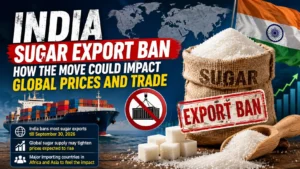
India has imposed a ban on most sugar exports with immediate effect till September 30, 2026, as the government looks to protect domestic supply and control local prices. The decision is expected to affect global sugar markets because India remains one of the world’s largest sugar exporters after Brazil.
The Directorate General of Foreign Trade changed sugar exports from “restricted” to “prohibited” for raw, white and refined sugar categories. However, certain exports to the United States and European Union under existing quota arrangements will still be allowed.
Why India imposed the sugar export ban
The government’s move comes as sugar production is expected to remain below domestic demand for the second straight year. Lower sugarcane yields in major producing states and concerns linked to weather conditions, including possible El Niño disruptions, have raised fears over supply shortages.
Reports suggest India may produce around 275 lakh tonnes of sugar during the 2025-26 season, while domestic demand could reach nearly 280 lakh tonnes. That could leave closing stock levels at one of the lowest points seen in recent years.
Also Read: Prateek Yadav autopsy reveals lung clot caused death, report mentions six injuries
Balancing ethanol blending goals with food security
Beyond managing direct consumer retail prices, the export freeze is closely tied to India’s aggressive Ethanol Blending Program (EBP) targets. By curtailing international shipments, the government ensures that domestic sugar mills retain sufficient sugarcane juice and B-heavy molasses reserves for ethanol production rather than exporting raw sugar abroad. Diversion toward biofuels helps reduce national crude oil import costs while providing domestic sugar mills with a stable, alternative revenue stream. Policymakers have chosen to prioritize energy security and domestic price stability over short-term international export revenues.
How global markets could be affected
The India sugar export ban is likely to tighten global supply, especially in Asian and African markets that depend heavily on Indian shipments. After the announcement, international sugar futures moved higher, with both raw and white sugar prices seeing gains.
Industry estimates indicate that nearly 90 percent of India’s sugar exports could be affected because the US and EU account for only a small share of total shipments. Countries including Somalia, Sudan, Djibouti, Bangladesh, Sri Lanka, Kenya and the United Arab Emirates are among the major buyers of Indian sugar.
The restrictions may also create opportunities for rival exporters such as Brazil and Thailand to increase shipments to international buyers.
Existing shipments may still move
The government has allowed some exceptions for cargo already in the export pipeline. Exports may continue if loading had already started before the notification, shipping bills were filed earlier, or consignments had already reached customs authorities.
India had earlier approved exports of 1.59 million metric tonnes of sugar. According to reports, contracts had already been signed for around 800,000 tonnes, with more than 600,000 tonnes shipped before the latest order came into effect.
Government-to-government exemptions and diplomatic considerations
While commercial trade channels face a strict complete ban, the Directorate General of Foreign Trade (DGFT) has retained flexibility for diplomatic concessions. The trade policy framework allows the Ministry of Commerce to evaluate specific bilateral requests from neighboring or partner nations facing critical food security emergencies. Special government-to-government (G2G) export allocations can still be cleared on a case-by-case basis. This operational exemption ensures that New Delhi maintains strategic diplomatic ties across South Asia and Africa without compromising its overall domestic buffer stock mandates
FAQs
Why did India ban sugar exports?
India introduced the restriction to maintain domestic supply and control rising prices as production is expected to stay below consumption levels.
Till when will the sugar export ban remain in force?
The restriction will remain effective till September 30, 2026, or until further government orders.
Which countries buy the most sugar from India?
Major importers include Somalia, Sudan, Djibouti, Bangladesh, Sri Lanka, Kenya and the UAE.
Will global sugar prices rise after the ban?
Global sugar prices have already reacted positively after the announcement due to concerns over tighter supply.
👉 Explore more latest updates, trending news, and expert insights on WizBloggers

